
It was found [1, 2] that in personal communication about 35% of the information is transmitted verbally, while the majority (over 60%), information is transmitted by non-verbal means - facial expressions, gestures, postures, etc. It was also found [1] that the expressions of basic emotions on the faces of the people do not depend on racial, cultural, gender or age of human origin. Emotions on the human face are equally well recognized by people in all corners of the Earth. This allows you to set the task of creating the intelligence system, which can recognize emotions and the true intentions of the person in his appearance and behavior in the communication process.
The aim of this work is to construct the algorithm for determining the emotional state of the person by analyzing the images of his face. To achieve the aim we need to solve the following tasks: 1. Obtaining of the human image and recognizing his face; 2. Image processing; 3. Creating image masks and performing brightness analysis of pixels; 4. Classification of the image (the definition of the emotions).
We consider the ideal case in which the original data are human photographs made from the front, and reflecting his various emotional states. An obligatory condition is the presence of human photos with neutral emotional background, which is taken as a template.
Researched emotions are anger, surprise, fear. Figure 1 shows a block diagram of the test algorithm. Figure 2 shows the original image and its mask.
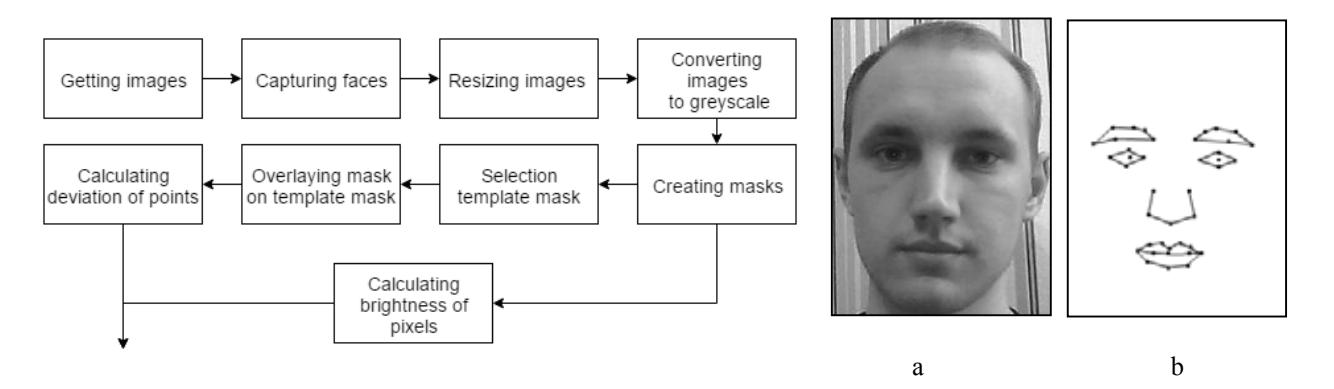
The chosen development software is package of computer mathematics Matlab. The choice is not random, as Matlab already has algorithms image processing, as well as packages for working with neural networks and fuzzy logic.
Currently, the main ways of expressing emotions of human are studied, the initial version of the algorithm for estimating the emotional state of a person analyzing facial images is developed, the database of images for later analysis is collected.
Further objectives are: recognition of a person's face, standing at different angles to the camera; using of additional criteria for the evaluation (brightness, contrast images, the comparison circuits); capturing images from a video stream; using of 3D - facial recognition; accounting entity of small details, specific facial expressions (increasing the number of mask points); an adaptation system to operate in realtime; recognition complex emotions; скуфештп an integrated system for determining emotion gestures, speech, gait, face.