Generation of broadband laser pulses, especially in the near and mid-infrared spectral range, is receiving increased amounts of attention from the scientific community due to its quickly developing applications in strong-field physics [1], [2]. Such broadband signals are mostly achieved using nonlinear parametric interactions, while the energy of the signal is generally increased via optical parametric chirped pulse amplification (OPCPA) [3].
We present experimental results of generation and parametric amplification of broadband pulses at 2 μm using methods of difference frequency generation (DFG) and OPCPA. A broadband chirped signal was generated by implementing DFG technique and amplified using a two-stage optical parametric amplifier (OPA).
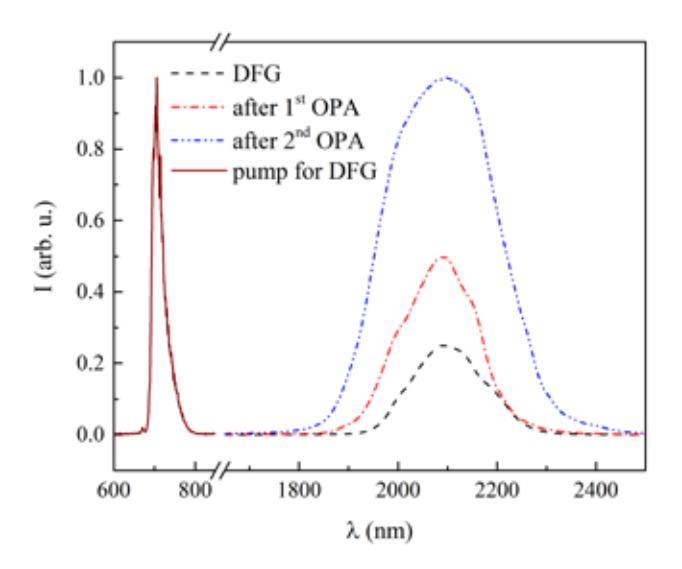
The whole system was based on Ti:sapphire oscillator providing femtosecond pulses at around 800 nm. It acted as a seed source for pump amplifiers and the broadband infrared signal thus providing optical synchronization between the two. In order to boost the energy of pulses generated by the oscillator, a parametric chirped pulse amplifier was employed. The signal of the oscillator was split into two parts. The first one was frequency-shifted and injected into Nd:YAG regenerative laser amplifier. By using additional amplifiers two parallel channels were set-up, each providing 50 ps long pulses and energy of up to ~2 mJ. In order to obtain reasonable efficiency of the parametric process, the second part of the oscillator signal was stretched in time up to more than 10 ps in bulk flint (SF57) glass. Initially, theoretical modelling was performed and gain bandwidth was estimated for all OPA stages utilizing noncollinear interaction and certain crystal length. Experimentally, the chirped pulse was parametrically amplified in two successive visible OPA stages based on BBO crystals using a noncollinear setup and the second harmonic of Nd:YAG amplifier as a pump. Afterwards, DFG was realized when the amplified stretched pulse was mixed with the fundamental frequency radiation of Nd:YAG amplifier in a thin BBO crystal using noncollinear geometry. Consequently, a broadband chirped signal with energy of up to 1 μJ and a spectral range of 1.9 - 2.5 μm was generated. Lastly, the generated broadband infrared signal was amplified in two OPA stages, first of which acted as a preamplifier and was pumped by the fundamental frequency of Nd:YAG amplifier's first channel. The second channel served as a pump for the last OPA stage. Noncollinear interactions were implemented in both stages and the final signal with ~250 nm spectral bandwidth at FWHM (see Fig. 1) and maximum energy of 0.5 mJ at 1 kHz repetition rate was achieved.