
Polymorphism can be described as the ability of substance to crystallize in different structures depending on the external conditions. More precise definition states that polymorphs are different in crystal structures, but melt giving identical liquids [1]. In our research we examined halogen derivatives of toluene in high pressure to determine how those compounds differ in their crystal structures and intermolecular interactions.
In our experiments we used Diamond Anvil Cell (DAC) to obtain high pressures. DAC creates homogeneous environment for an examined substance and requires very small quantities of the compound. This makes DAC an ideal tool for single-crystal X-ray diffraction experiments. However, as a consequence of reducing angular access to the sample, number of reflections that can be measured is reduced. Also, additional reflections coming from crystal structure of diamonds are collected.
Typical procedure of loading DAC (shown in Fig. 1) involves puting sample and a chip of ruby inside a small hole in a gasket. Then the sample is compressed by culets of two diamond anvils [2] that are pushed towards by screws that control the stability of pressure.
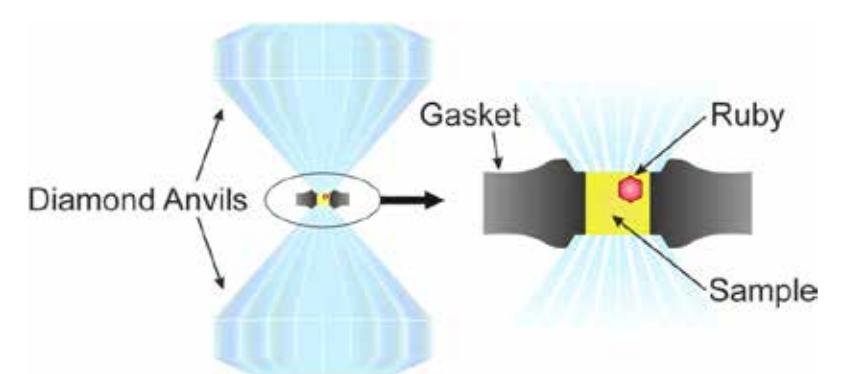
A chip of ruby that is loaded with a sample acts as a fluorescent pressure sensor. When illuminated by a laser, ruby fluoresces giving two R-line peaks. Shift of those peaks depends on the pressure inside the cell [3][4].
If sample is liquid under normal conditions, compressing results in polycrystallization of the sample. The next step is to raise the temperature up to the melting point so that there is only one crystallite left. Cooling the sample from that point results in growing a monocrystal inside DAC. Observing the sample between polarizer and analyzer gives a great insight into homogeneity of the crystals and allows for notification if any unwanted twinning occurs during cooling.
In our research we examined p-fluorotoluene, p-chlorotoluene, p-bromotoluene and p-iodotoluene behaviour in high pressure. We determined the structures they crystallize in sets of different pressures within the ranges of up to few GPa. Although in our research three of those compounds did not exhibit polymorphism, we managed to crystallize one of them in two different structures. We would like to discuss the results we obtained for the examined substances in high pressures with those that had already been achieved by low-temperature crystallization.
In all our experiments we used shorter wavelength (Ag Kα 0.56 Å) than those exploited in typical X-ray diffraction experiments (Mo Kα 0.71 Å and Cu Kα 1.54 Å). Shorter wavelength enables to collect more reflections in the reciprocal space and closer crystal planes may be measured, according to the Bragg's equation, Eq. (1).
$$n\lambda = 2d_{hkl}\sin\theta\tag{1}$$