
Ionic Liquids (ILs) or Room Temperature Ionic Liquids (RTILs) are organic salts which melt below 100 °C. Sometimes RTILs are called tunable solvents because by varying the anion and cation subsystems their properties are changed dramatically. Recently a strange water clusterization process called water pocket formation in RTILS was observed applying SAX, SANS and NMR techniques [1, 2]. The purpose of present work was to analyse the dynamics of water pockets formation applying 1H NMR and relaxation methods.
In present study six imidazolium based RTILs were used, namely 1-butyl-3-methylimidazolium nitrate/chloride/bromide/iodide/trifluoromethanesulfonate/tertafluoroborate ([bmim][NO3/Cl/Br/I/TfO/BF4]). NMR experiments were carried on Bruker AVANCE III HDNMR spectrometer operating at 400 MHZ frequency for 1H at 298K using Bruker BBO probehead. Precise dilution curves were measured by changing the solutions compositions and measuring chemical shifts. Exact minima of water chemical shifts are present for all ILs except [bmim][BF4] (Fig 1.).
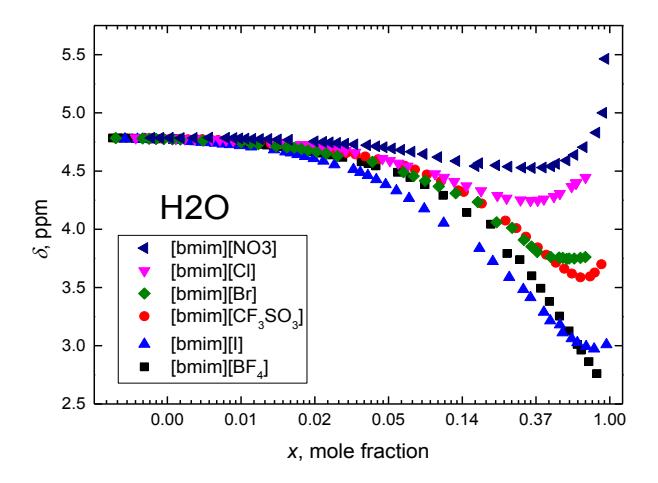
The observed chemical shift is the average value of all water manifolds in the sample. In our case the smaller the water pocket is the smaller chemical shift should be because relatively it would be constructed from more non-hydrogen bonded molecules in other words the shell would be relatively larger. Such dependency gives a hint that the water pocket diameter reduces within the anion accordingly d[NO3]>d[Cl]>d[Br]>d[TfO]>d[I].
Spin-Lattice T1 and Spin-spin T2 relaxations measurements corroborate water pockets formation in RTILs water systems. The minima are present at the same concentration in T1 dependency on concentration curves in all studied systems except [bmim][BF4]-water system. The next objective is to analyse inter- and intra- molecular parts of the relaxation process applying 2H NMR relaxation experiments.