
This paper focuses on the synthesis of magnetic iron oxide nanoparticles (MNP) and silver-coated MNP (SMNP) and the investigation of direct electron transfer between bacterial glucose dehydrogenase (GDH) from Ewingella americana and laccase from Didymocrea sp. through MNP and SMNP (Fig. 1).
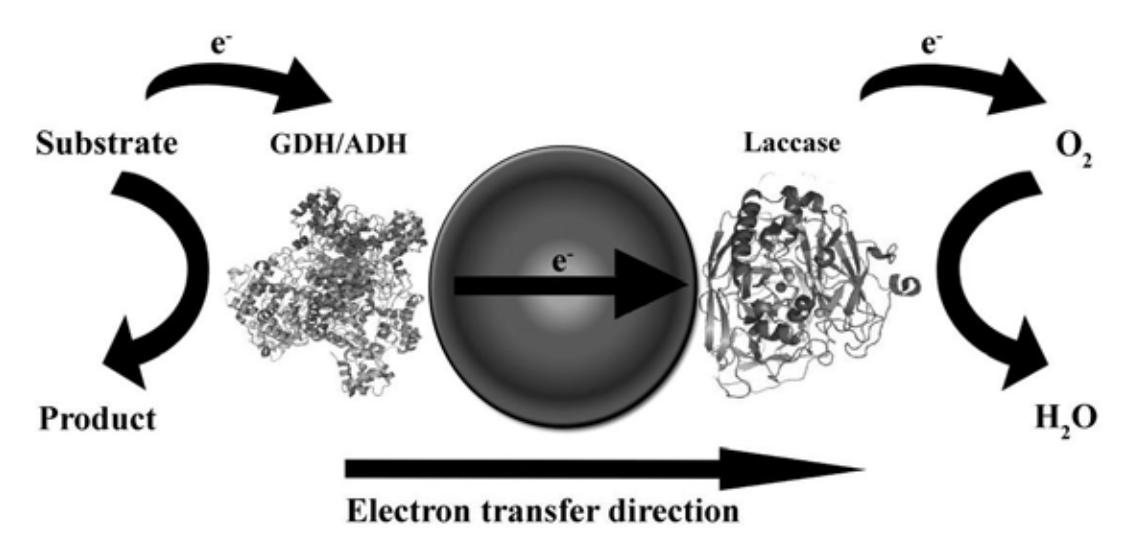
Magnetic iron oxide nanoparticles (MNP) were preapared by following the procedure described in the literature [1]. Ag-shell coating was performed by reduction of Ag- on the surface of iron magnetic nanoparticles using citric acid [2]. UV/VIS spectroscopy were used for nanoparticles characterization.
Lowry method and bovine serum albumin (BSA) as model protein were used to test the adsorption characteristics of MNP or SMNP.
Laccase and GDH were imobilized on the surface of MNP or SMNP by simple adsorption. The enzymatic activity of imobilized laccase was assayed spectrofotometically by measuring increase of absorbance at 414 nm of wavelength resulting from oxidation of 2,2'-azino-bis(3-ethylbenzothiazoline-6-sulphonic acid) (ABTS) and of imobilized GDH by measuring decrease of absorbance at 600 nm of wavelength resulting from reduction of phenazine methosulfate (PMS) and 2,6-dichlorophenolindophenol (DCPIP) mixture in the presence of glucose.
Oxygen electrode was used to follow oxygen consumption by bienzymatic MNP or SMNP. The oxygen consumption rate in GDH/MNP/laccase system in the presence of glucose was $2.09 \cdot 10^{-5} \mu M/s$. After addition of effective mediator ABTS, oxygen consumption rate increased and reached the value of $6.5 \cdot 10^{-5} \mu M/s$. The increase of oxygen consumption rate after mediator addition shows that MNP is not effective electron transducer in the bienzymatic system. In order to increase the efficiency of the electron transducer in the system, silver-coated MNP were used. In GDH/SMNP/laccase system oxygen consumption rate in the presence of glucose was $3.26 \cdot 10^{-5} \mu M/s$. After effective mediator ABTS addition, oxygen consumption rate almost unchanged and this shows that SMNP are more effective electron transducer than bare MNP.