
A large interest in the electromagnetic (EM) wave scattering problems appeared in the past decade. It was mainly caused by the rapid development in the field of metamaterials and their applications in electronics. The possibility of modelling different type structures renewed the interest in finding new applications for arrays of parallel cylinders in electronics [1]. 2D arrays of cylinders – photonic crystals – are widely used in optics as elements of devices that control a beam. Photonic crystals made of macroscopic size have lower requirements for surface processing and are easy to manipulate [2]. Such 2D arrays are a convenient object to study EM wave scattering, because it is possible to find an analytical solution of Maxwell's equations for such systems. In the analysis of problems of EM wave scattering by structures made of semiconductors the absorption is important because it is highly affected by changes in density and mobility of free charge carriers. The main advantage of such structures is that the concentration and mobility of free charge carriers can be controlled by changing the illumination, temperature and direct magnetic field. Furthermore using arrays of cylinders as a cloak from electromagnetic waves is suggested [3].
Good knowledge of the radial component of Poynting vector $P = [\vec{E},\vec{H}^*]$ is needed since it contains information about radial component of energy flux density of EM wave field. In Fig. 1 we present dependencies of $P_{\rho}$ for two different type photonic crystals with $N_q$ cylinders placed in a circle and submerged in a material cylinder (see Fig. 1 (d)).
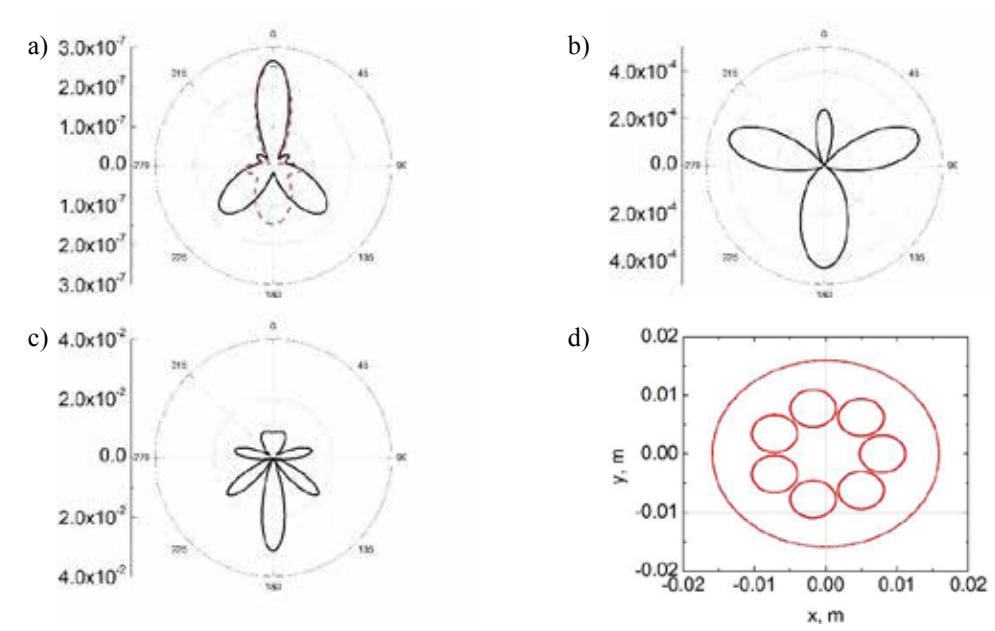
As seen in Fig. 1 (a) $P_{\rho}$ is almost independent on the number of submerged cylinders when they are placed in a concentric manner for the polarization $\vec{E}_0 = (0,1,0)$. A completely different behavior is exhibited for polarization $\vec{E}_0 = (0,0,1)$ Fig. 1 (b) and (c). The incident wave is monochromatic linearly polarized plane wave. Inner cylinders are made from silicon submerged in a glass cylinder, with permittivity $\varepsilon_{\rm Si} = 11.8 - {\rm i}/(\omega \varepsilon_0 \rho_{\rm Si})$, $\varepsilon_{\rm Glass} = 4 - 0.001{\rm i}$, here $\omega = 2\pi f$, f = 9 GHz (frequency of the incident wave), $\rho$ - specific resistivity, $\rho_{\rm Si} = 1$ $\Omega$m. The radius of material cylinder R=16 mm, radii of submerged cylinders $R_i=3.2$ mm. Distance from the material cylinder at which $P_{\rho}$ is calculated – D=53mm.