Upconverting nanoparticles (UCNPs) have found a potential uses in many applications such as biological imaging, cancer-targeting or drug delivery [1]. However, these applications of such nanomaterials are still restricted due to the hydrophobic oleate capping ligand and low upconversion efficiency.
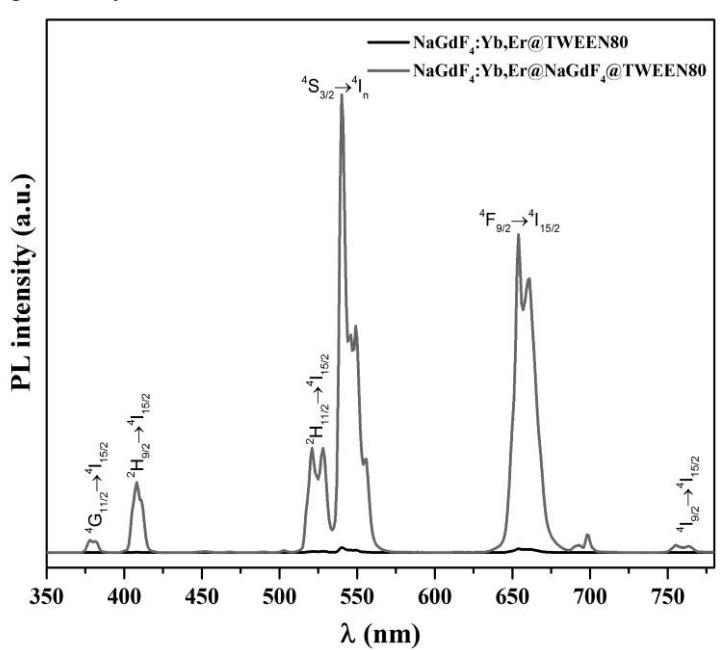
In this study, hydrophobic UCNPs was converted into hydrophilic ones using a commercially available surfactant Tween 80. Furthermore, it is shown that the epitaxial growth of an optically inert NaGdF4 layer around NaGdF4:Yb,Er core nanoparticle effectively prevents surface quenching of excitation energy. Scanning electron microscopy (SEM), powder X-ray diffraction (XRD), and photoluminescence (PL) spectra have been used to characterize the size, crystal structure and emission color of the samples, respectively. Photoluminescence data indicates that the upconverting fluorescent intensity of NaGdF4:Yb,Er@NaGdF4@Tween80 was obviously higher than that of NaGdF4:Yb,Er@Tween80 (Fig. 1). The outer NaGdF4 layer protects the inner core and its crystal structure, thus enhancing the fluorescence. Due to the good water-solubility and strong UC luminescence, these hydrophilic nanocrystals may be used for imaging and detection applications in biological assays.