Laser beam-pointing stability and control is a topic of great interest in modern science due to the increasing complexity of laser systems [1]. Beam-pointing fluctuations, which are primarily caused by air circulation, convection, temperature and mechanical vibrations can have a negative impact on the operation of such laser systems [2]. High power ultrashort pulse laser system is being developed at Vilnius University Laser Research Center which will be used for high-order harmonics generation in the not too distant future. In order to achieve maximum generation efficiency, laser beam will have to hit a small hole in a needle with 10μm accuracy. Therefore an active beam-pointing stabilization system will be used. We present the design, capabilities and test results of the system that was developed for this task.
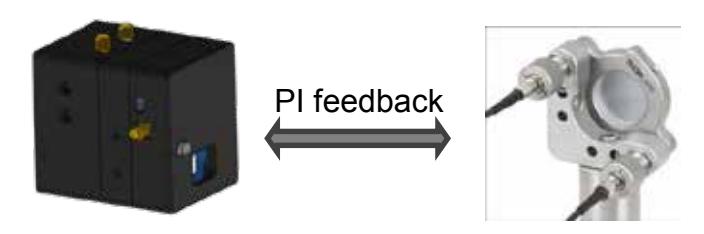
Beam-pointing stabilization system consists of position detectors and controllable mirror mounts connected in closed loop (Fig.1). Beam position is detected with cameras that were developed by Light Conversion Ltd. and are capable of calculating the position at 140Hz frequency. The direction of the beam is controlled by PolarisTM (Thorlabs) mirror mounts with integrated linear piezo elements which offer 500μrad angular range with 0.5μrad precision. PI feedback controllers are integrated inside the cameras providing 0-140V signal to the mirror mounts with 16bit resolution.
We investigated the beam-pointing stability of the laser system and the sources causing fluctuations. It was determined that short term stability of Yb:KGW laser which is the starting point of the laser system is around 1μrad in both axes and can deviate by as high as 60μrad after initial start. We also observed that air ventilation systems present in the laboratory can have a significant impact on the beam-pointing stability and equipment using active cooling can cause major fluctuations.
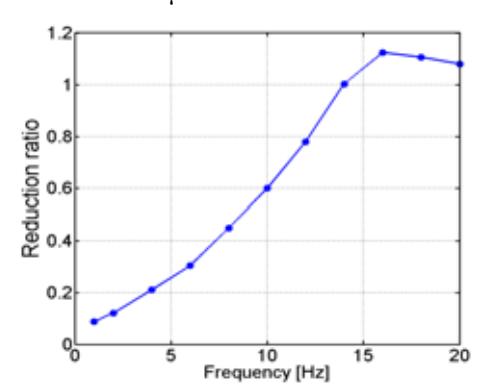
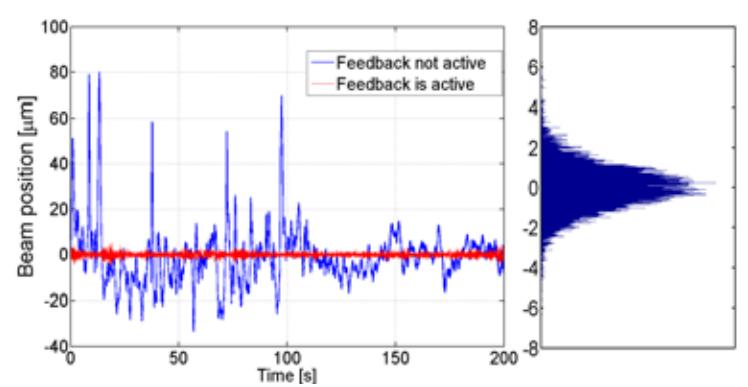
The active beam-position stabilization system was tested experimentally. We determined that it is capable of reducing fluctuations with frequencies of up to 14Hz (Fig. 2) while higher frequency fluctuations are being amplified by the active control. We also tested how it performs over a large distance when laser beam has to travel more than 10 meters and pass three separate tables. Two pairs of cameras and pieso mirror mounts were used in the experiment. The results with and without stabilization are presented in figure 3. Beam-pointing fluctuations reaching as high as $100\mu m$ were successfully reduced by active stabilization system which proved to be capable of keeping beam position with $\pm 5\mu m$ precision and $1.2\mu m$ standard deviation.