
Carbon fibre composite materials (CFC) have been used as divertor and plasma facing materials in the vacuum vessel of the Joint European Torus (JET) until 2009 and as substrate for tungsten-coated tiles in the JET ITER-like wall (ILW) divertor [1]. These materials can be used for the fusion applications due to low Z and good thermal-conductivity.
Operation of plasma in fusion reactors causes plasma-wall interactions (PWI): like erosion, formation of co-deposited layers and dust and flakes, fuel retention, formation of fullerenes [2], causing decrease in amount of fusion fuel and shortening lifetime of divertor materials. Formation of long-chain hydrocarbons and fullerene like compounds also can take place in plasma-wall interactions.
During PWI tritium can be captured in erosion products, deposited layers. Chemical reactions, like formation of long-chain hydrocarbons, can take place [3]. Therefore, it is important to investigate possibilities of determination of such hydrocarbons in dusts and flakes from a fusion reactor.
Long-chain hydrocarbons with and without addition of carbon-based dusts (C-dust) prepared from CFC are analyzed, in order to understand ways of tritium accumulation and formation mechanisms of various compounds including long-chain hydrocarbons in materials collected from a fusion reactor.
To characterize structure and chemical composition of the plasma exposed and non-exposed materials, Raman, Fourier transformation infrared spectroscopy (FT-IR) and Scanning electron microscopy together with energy dispersion X-ray spectroscopy (SEM-EDX) were used.
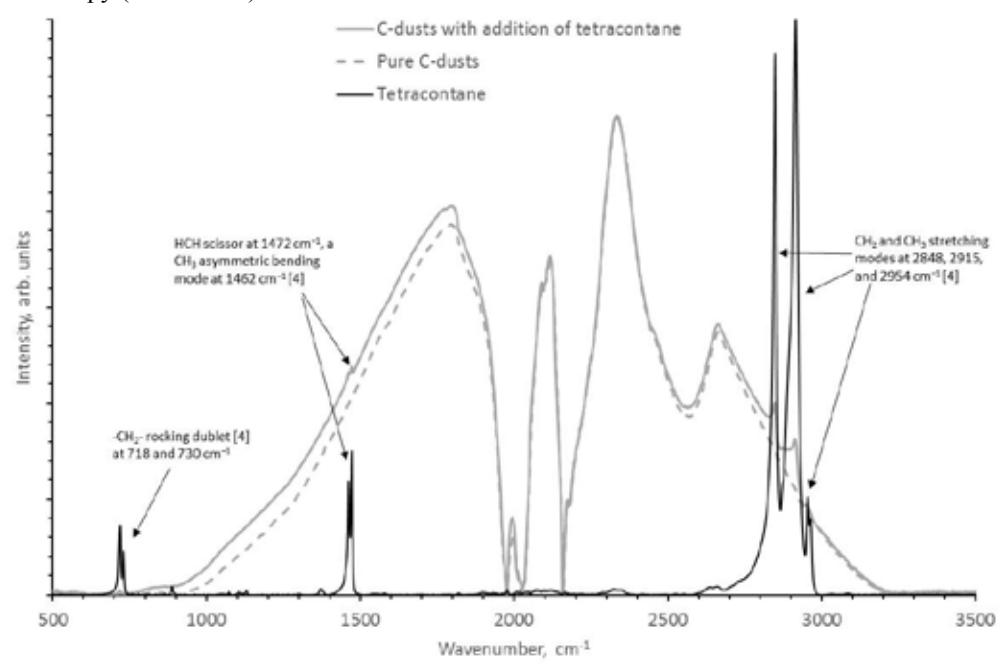
It was obtained, that presence of <5 wt.% hydrocarbons in non-irradiated C-dust can be determined by using FT-IR spectroscopy, by CH2 and CH3 stretching modes at 2848, 2915 and 2954 cm-1 and by weaker signal HCH scissor at 1472 cm-1 [4]. FT-IR and other above mentioned methods can be successfully used to determine chemical composition of carbon based dust and flakes from a fusion reactor.