
The use of nanosatellites (artificial satellites with mass between 1 and 10 kg) for space missions is significantly increasing due to relatively simple design and launch process compared to bigger satellites. CubeSat, one of the nanosatellite standards, is often used for research and education purposes, as well as for experiments that may be too risky to perform using bigger satellites.
Orbital decay caused by Earth's atmospheric drag greatly limits the mission time of small artificial satellites. In order to extend the orbital lifetime, miniaturized propulsion systems are being researched and developed by academic and industrial institutions.
CubeSat LituanicaSAT-2 is being developed by Vilnius University and NanoAvionika, JSC. This joint team is a member of QB50 project, meant to launch 50 satellites simultaneously into orbit and perform coordinated research of lower layers of Earth's thermosphere, measuring concentration of atomic oxygen [1]. Another objective of LituanicaSAT-2 is to test new rocket engine, using ADN-based monopropellant fuel blend [2].
The aim of this work is to prepare the equipment for measuring thrust force produced by the engine and heat generated by catalyst heater. Since the atmospheric pressure significantly decreases produced thrust force and convection decreases performance of the catalyst heater, the engine tests must be performed in vacuum chamber. Thrust force was measured using pendulum, shown in Fig. 1. The swing (1) and a frame – on which the swing is placed (8, 10), were balanced to touch the load cell (2). The engine was placed on the plate (9) so that the thrust force would push the swing onto the load cell. The S-beam load cell used in the experiments can measure forces up to 1N. Additionally, K-type thermocouple was used to monitor the temperature of the engine. The hardware and software to acquire the experimental data were developed and callibrated using high-precision tools. The pressure in the vacuum chamber was monitored using factory-callibrated pressure gauge. Vacuum pressure dynamics were used to determine engine characteristics such as mass flow.
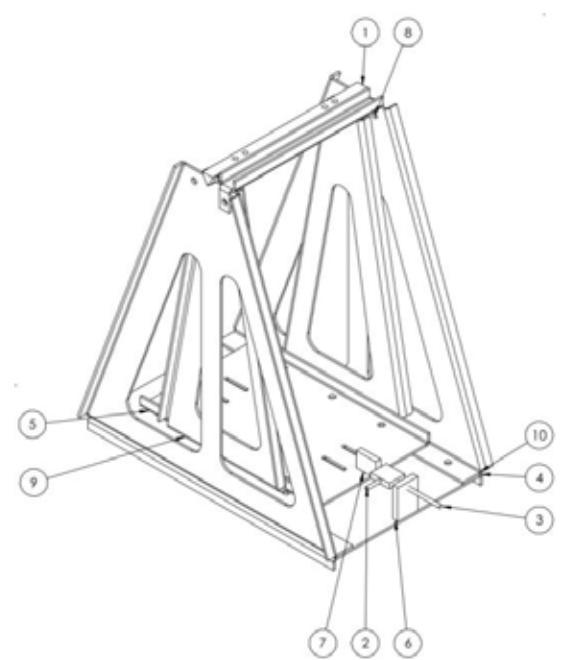
It was concluded that the response time of sensors is quick enough to perform accurate measurements. Initial tests confirmed that this test stand is suitable to perform firing tests of various small rocket engines in vacuum environment.