In recent years, lithium gallate (LiGaO2) has attracted wide interest in both academia and industry as a lattice-matched substrate for an epitaxial growth of optoelectronic semiconductors such as ZnO, GaN and InN [1]. Large ~70 mm wafers and good quality (less than 4.6 × 10⁴/cm2 defects) single crystals can be grown by the Czochralski method. The structure of LiGaO2 crystal is orthorhombic with space group Pna21 and with lattice parameters a = 5.402 Å, b = 6.372 Å and c = 5.007 Å. The unit cell contains four molecules, and every atom is tetrahedrally coordinated with the arrangement of the wurtzite-like structure. LiGaO2 show high phonon-mediated thermal conductivity, which is more than 1 W/cm·K, and knowledge of optical and vibronic properties and phonon interactions are of importance.
In this work we present results of polarized-transmittance and -reflectance spectroscopy study which was combined with Raman measurements. An employment of all three spectroscopic techniques allow us to determine optical phonons modes and distinguish transverse and longitudinal phonon's frequencies. Experimental measurements were performed on set of samples which were grown by Czochralski method. Samples were cut from grown bulk crystal and oriented along principal crystallographic planes (001), (010) and (100). Normal incidence transmittance and specular reflectance measurements were performed in the 100 – 7500 cm-1 spectral range with a resolution of 2 cm-1 using Vertex 70v vacuum FT-infrared spectrometer. The polarizer was oriented in the light path to make electromagnetic wave vector parallel to along crystallographic directions E || a, E || b and E || c. To obtain the absolute reflectivity, the reflectance of the evaporated gold film was taken. The FT-infrared Raman scattering measurements were performed in a backscattering configuration on a RAM II module which is attached to Vertex spectrometer. Raman scattering measurements were carried out using 1064 nm excitation wavelength.
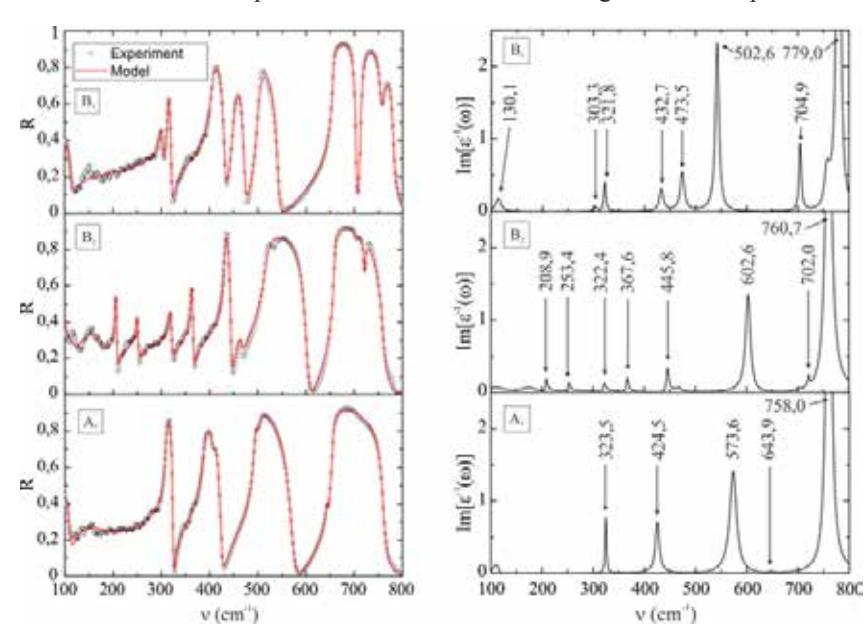
The polarized reflectivity spectra along a, b and c axis shown in Fig. 1. The reflectance in all three directions are dominated by the contribution from the phonons. According to group theory analysis, LiGaO2 should have the Brillouin zone center modes at the Γ point with Γ = 11A1(c) + 11B1(a) + 11B2(b) + 12A2. The B1, B2 and A1 modes are infrared active, corresponding to the polarization directions E || a, E || b and E || c, and the A2 mode is only Raman active. Combining reflectivity and Raman data we identified 30 optical phonons modes and determined longitudinal and transverse frequencies. Experimental IR reflectance data were analyzed using complex dielectric function ε(ω) which was modeled by sum of Lorentz's oscillators. Frequencies of transverse optical phonons were calculated from imaginary part of dielectric function Im[ε(ω)] and longitudinal frequencies from energy loss function Im[-1/ε(ω)]. Experimental transmittance data above 800 cm-1 revealed optical features which can be assigned to multi-phonon absorption.