The efficiency of InGaN light-emitting diodes (LEDs) becomes limited at high carrier densities, the effect known as the efficiency droop. There is an ongoing debate as to the physical origin of the non-radiative recombination mechanism, which is responsible for this effect [1]. This task is burdened by many variables usually present in the studies so having fewer parameters would be favorable. In this work, we study a large number of InGaN quantum well structures with varying thickness, composition and quality. We demonstrate that there is a strong negative correlation between the carrier diffusion coefficient and quantum efficiency, regardless of the structure details. It proves that the carrier mobility is a governing parameter in the efficiency droop process.
The investigation was carried out in more than 30 different multilayered quantum well (QW) structures, emitting light in 410-580 nm spectral region. All samples were grown by metalorganic chemical vapor deposition (MOCVD) on c-plane sapphire substrates. Samples were grown by five different growers in several separate reactors, and have different indium content (from 5% to more than 25%), number of quantum wells (from 1 to 10), quantum well width (from 2 to 6 nm), etc. Photoluminescence (PL) and light-induced transient gratings (LITG) [2] techniques were used in this study. For the evaluation of PL quantum efficiency (QE), the three-measurement approach with an integrating sphere was applied [3]. The selective excitation at 393-405 nm of the samples allowed to monitor processes directly in QWs, but not in GaN barriers.
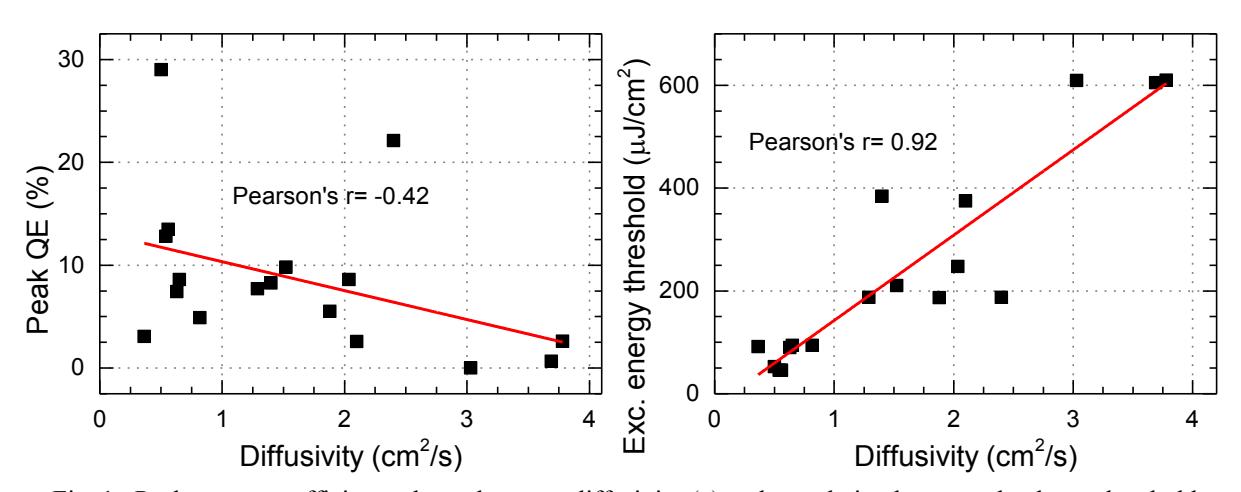
The results show a decrease in PL peak quantum efficiency with the increase in diffusivity (Fig. 1a). The value of diffusion coefficient D in each sample was measured at the excitation energy fluence at which efficiency droop (i.e. the peak QE) occurs. This trend proves that although samples are different, diffusivity is one of the key parameters governing the peak quantum efficiency. This can be explained with the density activated defect recombination (DADR) model [4]. In this model as the excitation energy fluence rises, the saturation of localized states leads to the excitation of charge carriers into the extended states where they have greater mobility and can reach non-radiative recombination centers more easily. Hence, higher mobility of these extended states results in bigger non-radiative losses. Fig. 2b shows that excitation energy fluence threshold at which droop occurs directly correlates with diffusivity (with Pearson's r= 0.92). Higher thresholds in the samples with lower QE (which in turn is generally ascribed to higher density of defects, what increases the rate of non-radiative recombination) compliment the correlation seen in Fig. 1a.