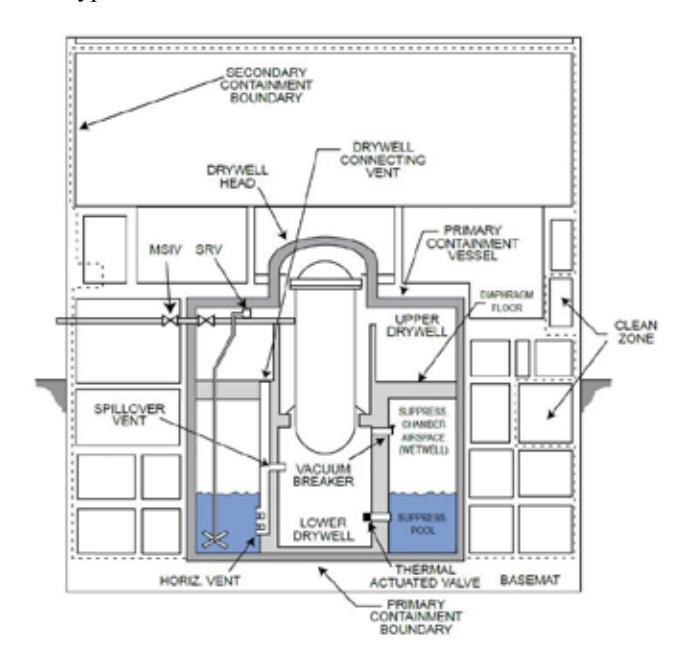
Nuclear energy performs a significant role in a world energy demand. By using this energy source we are able to ensure large capacity, diversified energy supply with stable baseload, low carbon electricity. However, for further nuclear energy development we need to ensure nuclear and radiological safety, which will overweight the cons and solve the problems related with this energy source. One of these methods is a radioactive contamination incident simulation and modeling, where the most important aspect is radionuclides dispersion into environment.
For this purpose we are using ASTEC (Accident Source Term Evaluation Code) program to simulate and to evaluate potential consequences of nuclear incident or accident. We are using one of several ASTEC modules CPA (Containment Part of the integral code Astec). This module calculate thermal hydraulics and aerosol behaviour in LWR (Light water reactor) technological channels and compartments. CPA module is composed of two parts: THY and AFP. First one calculates temperature and pressure variations and distributions, as well as heat exchange with compartment walls. Second, CPA-AFP module calculates aerosols dispersion and depletion. CPA principle is based on FIPLOC (Fission Product Localisation) code. By using this code we are able to model up to eight different aerosol component size classes. All relevant agglomeration processes, natural deposition processes and the droplet growth by fog formation are included. The aerosol retention by filters, water pools (pool scrubbing), and containment sprays is modeled. In the aerosol module all essential interactions thermal hydraulic phenomena, iodine behaviour, and decay heat are taken into account [1]. CPA modeling includes aerosols simulated phenomena behaviour of non-soluble and hygroscopic aerosols, fission product transport. Processes modeled for the simulation of aerosol behaviour: agglomeration, condensation on aerosols, sedimentation, diffusiophoresis, thermophoresis, diffusion and aerosols removal by spray [1].
We are using this code to evaluate fission radionuclide dispersion in Advanced Boiling Water Reactor (ABWR) building compartments due to some hypothetical incident.