
Some patterning methods use nanoporous anodic alumina membranes as templates in order to obtain ordered arrays of nanostructures (nanodots, antidots and nanowires) [1-3]. Their hexagonally close packed structure can be easily tuned by the type of the electrolyte and the applied voltage. This work presents variations of the morphology of porous Anodic Aluminium Oxide (AAO) templates prepared by anodization of Al films deposited either on metal, or on semiconducting or dielectric substrates which are a barrier between the anode and the anodized film. Metallic Al films were deposited in high vacuum (~10-6 mbar) on Ti, Si, and Si/SiO2 substrates. The anodization was carried out in sulphuric, oxalic and ortho-phosphoric acids at constant voltages of 25 V, 40 V and 185 V, respectively. The current-time dependence during anodization process was registered for each type of substrate. The morphology of the produced membranes was studied by Scanning Electron Microscopy (SEM) and Atomic Force Microscopy (AFM).
It was found that the cell diameter (the distance between the centres of neighbouring pores, DC) of the fabricated oxide is less sensitive to the type of substrate than to the electrolyte type and the applied voltage. On the other hand, the decrease of pore diameters (DP) of AAO prepared on semiconducting and dielectric substrates in comparison with AAO prepared on the TiO2-free Ti substrate turned out to be significant. The latter effect can be explained by the decrease of the anodizing current density, which is detemined by conductivity of the substrate. Besides, it was found that for AAO prepared on the Si/SiO2 substrate each cell contains a few additional pores with diameter ~15 nm.
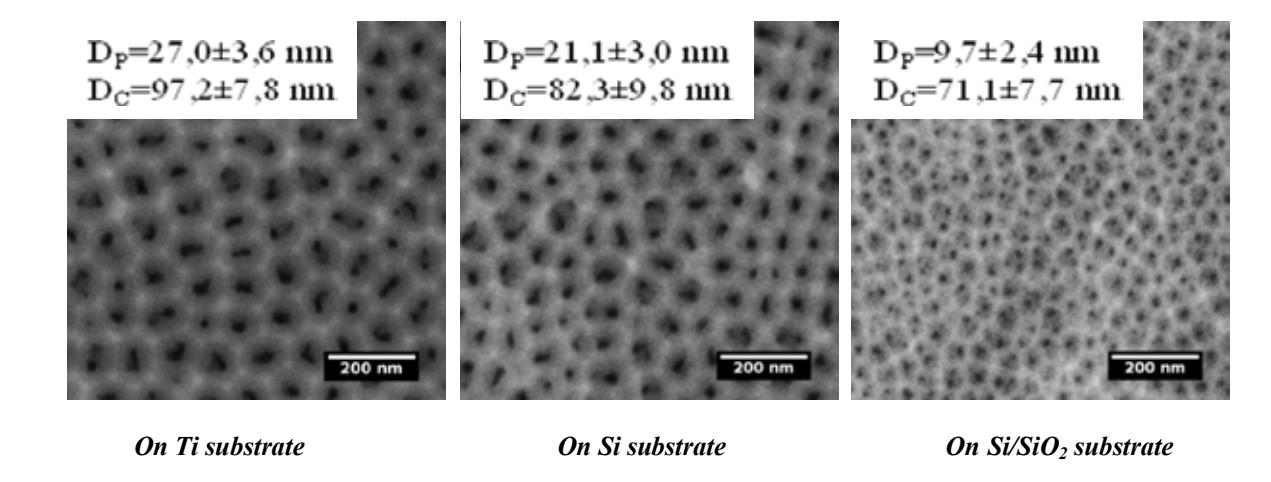
Electric conductivity of the substrate is additional parameter which allows to adjust not only the diameter of the basic pores of the anodized alumina but also the number and the diameter of additional pores inside the elementary cell.