
The Higgs mechanism [1] as a part of the electroweak theory [2] forms the core of the Standard Model. Most of its predictions are experimentally verified with the Higgs boson as the last missing piece detected in 2012 with a mass $m_{H} = 125.09 \pm 0.21\text{(stat.)} \pm 0.11\text{(syst.)}$ GeV [3].
Nevertheless several theoretical questions are not answered yet, allowing for extensions of the Standard Model. The two-Higgs-doublet model is one of the simplest extensions of the Standard Model Higgs sector. It consists of two complex SU(2)-doublet scalar fields, while in the Standard Model there is only one complex scalar Higgs field. The addition of the second Higgs doublet leads to the generation of the five physical Higgs bosons: two neutral CP-even Higgs bosons, h and H, with $m_{H} > m_{h}$, a neutral CP-odd or pseudoscalar Higgs boson A, and a pair of charged Higgs bosons H\pm. So far only the Standard Model like Higgs boson h was found. The Higgs Hunter's Guide [4] lays out search strategies for the other Higgs bosons. The program 2HDMC [5] helps the prospective Higgs hunter to calculate the properties of the studied two-Higgs-doublet model theoretically.
Haber and collaborators noticed, that there is an arbitrariness left in the choice, how we distribute the physical Higgs fields among the two complex SU(2)-doublet scalar fields and described a basis independent formulation for the potential of the two-Higgs-doublet models [6]. Their notation is advantageous in new implementations of the two-Higgs-doublet model together with the seesaw mechanism as an extension of the Standard Model [7]. But this notation is not implemented in the 2HDMC.
Historically people distinguish different two-Higgs-doublet models by their fermion couplings. In the type I models the Higgs doublets can be defined in such a way that all fermions couple only to a single Higgs doublet. In type II the down-type fermions couple to one Higgs doublet and the up-type fermions to the other. The parameter $\tan \beta$ relates the vacuum expectation values of the two doublets.
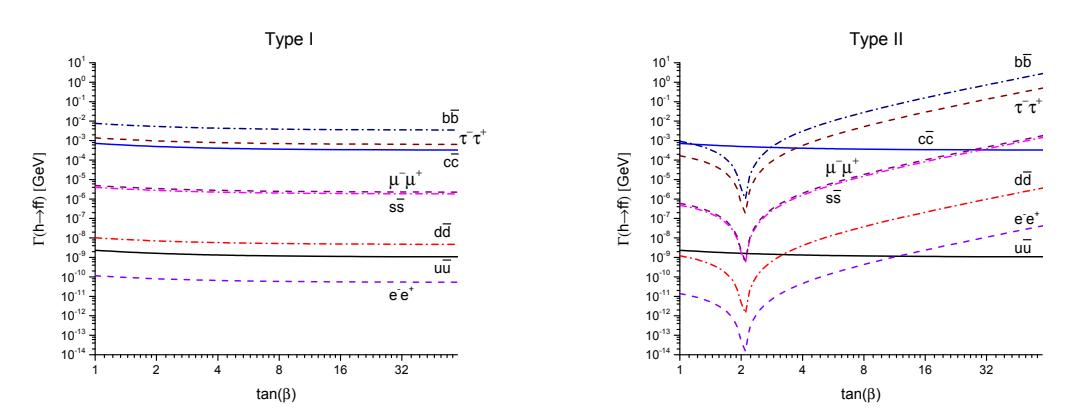
We derive the connection between the input for 2HDMC and the notation of the general formalism of [6]. With this connection we compare the results from 2HDMC with our general decay width calculations [8] and confirm the correctness of the code.