
One of the fundamental aspects of complex systems are the transport properties. Transport properties in complex systems are usually characterized by anomalous scaling, that is by a non-linear time dependency in the growth of the variance, $\sigma^2(t) \sim t^{\mu}$, where t is the elapsed time. This condition is known as an anomalous diffusion. In contrast to the anomalous diffusion, in a typical diffusion process the variance of the particle position (or mean squared displacement) is a linear function of time. Anomalous diffusion is classified by its power law exponent $\mu$. If $\mu > 1$, the phenomenon is called super-diffusion. Super-diffusion has been experimentally observed in a study of tracer particles in a two-dimensional rotating flow [1]. If $\mu < 1$, the particle undergoes sub-diffusion. Sub-diffusion has been proposed as a measure of macromolecular crowding in the cytoplasm [2]. Experimental studies shows that anomalous scaling of variance and power law statistics (power law spectral density (PSD) and power law steady state probability densities (PDF)) can occur together[3]. Usually, these processes are modeled as separate and independent. So there is a need for model describing a system with bought anomalous diffusion and power law statistics.
Stochastic differential equation (SDE) that generate signals with power law statistical properties have been proposed
$$dx = \left(\eta - \frac{1}{2}\lambda\right)x^{2\eta - 1}dt + x^{\eta}dW(t). \tag{1}$$However, proposed SDE generated signals variance do not exhibit anomalous power law growth [4]. The simplest known model of super-diffusion is Lévy $\alpha$ stable process $L_t^{\alpha}$. We modified Eq. (1) by replacing Wiener $W_t$ process to Lévy stable process $L_t^{\alpha}$
$$dx = \gamma(\eta, \lambda, \alpha) x^{\alpha(\eta - 1) + 1} dt + x^{\eta} dL_t^{\alpha}. \tag{2}$$Proposed SDE generate signals with power law PDF $(P(x) \sim x^{-\lambda})$ and spectral density S(f)
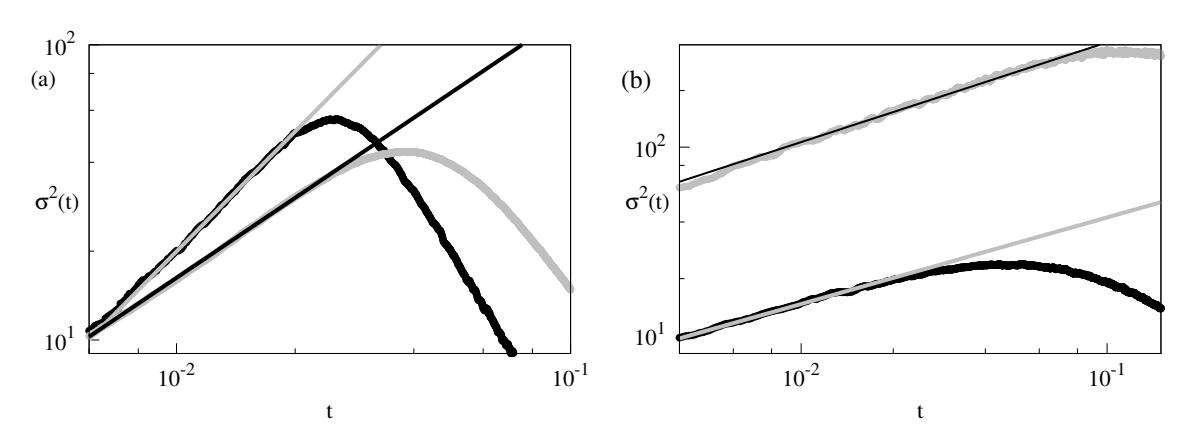
$$S(f) \sim \frac{1}{f^{\beta}}, \qquad \beta = 1 + \frac{\lambda - 3}{\alpha(\eta - 1)}. \tag{3}$$In addition, numerical results show that due to presence of the multiplicative Lévy $\alpha$ stable noise process in Eq. (2) both sub-diffusion and super-diffusion can occur (see Fig. 1). This is in contrast to the SDEs with additive stable stochastic process, when only sub-diffusion is possible unless more complex non-Markovian models are used [5].
In conclusion, we have proposed nonlinear stochastic differential equations driven by Lévy $\alpha$ stable process that generate signals exhibiting power law statistical properties. In addition, such nonlinear SDEs can lead to Lévy flights with anomalous diffusion, both sub-diffusion and supper-diffusion.