
Currently InGaN/GaN based light-emitting diodes (LEDs) continuously strengthen their footprint in the market of general lighting. However, their performance is far from the ultimate efficiency. Nanorod-based LEDs are believed to be one of the most promising concepts for efficiency enhancement. Specifically, GaN nanorods are found to dramatically reduce the dislocation density in the upper part of nanorods. Moreover, nanorods with a small area of contact with the substrate tend to relieve the strain induced by thermal expansion mismatch. However, it is necessary to fully understand the properties of nanorods, before they can be widely applied.
In this work, the photoluminescence (PL) properties of GaN nanorods with InGaN/GaN core-shell multiple quantum wells (MQWs), grown by metal-organic vapour phase deposition with different trimethylindium (TMIn) gas flow rates (80, 160, 320 sccm), were studied using a confocal microscope. Three different samples of nanorods were excited with a 405 nm laser focused through a NA=0.9 100× objective. The PL signal was directed to a spectroscope coupled with CCD camera through an optical fiber. Spatial distributions of PL parameters were measured at three areas on each nanorod: the top, middle and base. Additionally, polarization-dependent PL measurements were performed. Average degrees of polarization (DOP) and DOP spatial distributions were obtained for each area.
Results show that all PL spectra consist of two bands, one of which is associated with the QWs emission, while the other is a defect-related GaN yellow-band. As TMIn flux rate is increased, the PL peak position redshifts from 450 to 530 nm. The spatial PL intensity distribution measurements show that intensity is distributed non-uniformly; a larger density of bright dots at the top than at the bottom part of nanorod was observed. It implies that quantum wells are deposited inhomogeneously on the GaN rod. The increase of excitation intensity by an order of magnitude did not change the PL peak positions (Fig. 1). These results suggest that QWs are grown on non-polar planes.
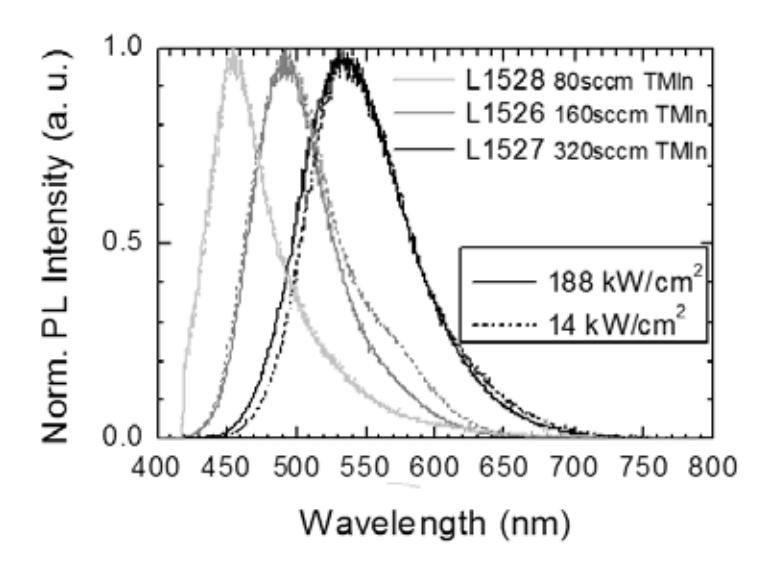
In order to ensure that the planes are non-polar, polarization measurements were carried out. The emission band that is associated with QWs, proved to be significantly more intense when the polarizer is oriented perpendicularly to the c-direction rather than parallely. This proves that QWs are grown on non-polar planes. Additionally, it was found that DOP decreases from the top (up to 0.5) to the base (~0.1) of nanorod. By comparing spatial PL intensity and spatial DOP distributions it was found that areas of higher intensity correspond to areas of higher DOP. The GaN yellow-band's position and peak intensity did not change when the orientation of polarizer was changed.
Moreover, periodical oscillations of PL spectra were observed. Calculations of cavity thickness proved these local peaks to correspond to Fabry-Perot interference maxima. It shows that Fabry-Perot modes occur between opposite facets of the nanorod.
To conclude, high spatial resolution measurements of GaN nanorods showed that PL intensity distribution is inhomogeneous. This suggested that QWs are deposited non-uniformly on the GaN rod. Results of PL measurements at different excitation power densities and different polarization angles suggest that QWs are grown on non-polar planes. The degree of polarization was higher at top and decreased at the base of the nanorod due to peculiarities of QW growth.