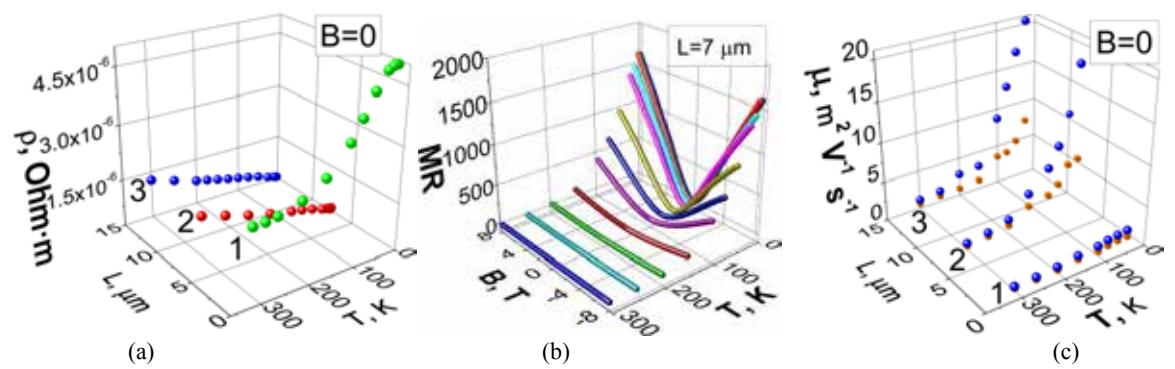
The goal of this work is to study influence of grain size of polycrystalline Bi films on charge carriers scattering mechanisms, resistivity $\rho$, relative magnetoresistance MR, Hall coefficient $R_H$ and Seebeck coefficient S. Bi films were fabricated by melt spinning and electrochemical deposition (with further annealing). Microstructure of samples investigated by scanning electron microscopy (SEM), X-ray diffraction analysis and electron diffraction analysis. Temperature and magnetic field dependences of $\rho(T,B)$ (fig1.a), MR(T,B) (fig1.b), $R_H(T,B)$ and S(T,B) were measured in cryogenless system CHNF (Cryogenics Ltd) on the basis of close-cycle in temperature range $4 < T < 310$ K under magnetic fields up to $B < 8$ T. Experimental setup allowed to measure and stabilize temperature with accuracy up to 1 mK, determine resistivity and Hall coefficient with measuring error less 0.1% and Seebeck coefficient with error less than 10% at temperatures lower than 20 K and less than 0.5% at $T > 100$ K.
On the base of solution 3D initial-boundary problem for partial differential equation system describing coupled transport of charge and heat [1] method for computation of Seebeck coefficient of film is proposed. The only inputs required for the method are tensor transport coefficients for single-crystal and experimentally obtained crystalline texture mapping of the film. Numerical processing of experimentally measured $\rho(T,B)$, MR(T,B), $R_H(T,B)$ and S(T,B) allowed to calculate temperature dependences of mobilities and concentration for electrons and holes using approach described in [2] (fig. 1c), which helped to explain changing of charge carriers mechanisms with increase of grain size.
Performed study enabled to develop technology for synthesis of polycrystalline Bi films with controllable properties for their usage as thermometer and heater for experimental implementation of thin film thermal conductivity measuring technique known as $3-\omega$ method.