The Large Hadron Collider (LHC) based at the laboratory of the Conseil Européen pour la Recherche Nucléaire (CERN) near Geneva, Switzerland, resumed its operations after the planned shutdown. In April 2015 the accelerator reached the center-of-mass energy level of proton-proton collisions of 13 TeV.
After the discovery of the new particle around 125 GeV/c2 [1, 2], which was announced as the Higgs boson, experimental research will further investigate Higgs mechanism [3, 4]. A few decay channels of the Higgs boson are still to be confirmed by reaching the statistical significance of five standard deviations ($5\sigma$), including $H \to \tau^{-} + \tau^{+}$, for which the main background is the Drell-Yan process $Z/\gamma^{*} \to \tau^{-} + \tau^{+}$. The purpose of this study is to develop a cut-based analysis algorithm that would help to discriminate these events with the Compact Muon Solenoid (CMS) detector and would allow researchers to reach the required statistical significance for confirmation of the decay channel, without a need for an additional large amount of data. The focus is on the property of $τ$ leptons called polarisation as it differs in the signal and background events. The difference in polarisation reflects in energy distribution among the decay products of $τ$ leptons, which themselves are not observed in the detector because of their short lifetime of $(290.6\pm 1)$ fs [5]. $τ$ leptons are reconstructed from their decay products, but as neutrinos are not detected and carry a part of the energy away, the $τ$ lepton candidate has a lower measured energy, called the visible energy $E_{vis}$. The decaying $τ$ lepton has the total energy $E_{tot} > E_{vis}$.
The production of the Higgs boson through gluon-gluon fusion in a proton-proton collision as well as the production of the Z boson through a quark-antiquark annihilation and their decay to $τ$ leptons were simulated using Pythia 8 [6], a generator for high-energy physics based on principles of Monte Carlo method. The simulated events were processed with GEANT4 [7, 8], a software package which emulates the response of the CMS detector to the particles produced in an event and which pass through the detector. The simulated detector response was further processed with the standard CMS event reconstruction software CMSSW. Simulated data provides two layers of information on the same event. The generator (GEN) level possesses information about all particles simulated in the event - their relations to each other, energies, momenta, etc. The second layer is the reconstructed (RECO) level, which is purely an emulation of what can be reconstructed from this event with the detector.
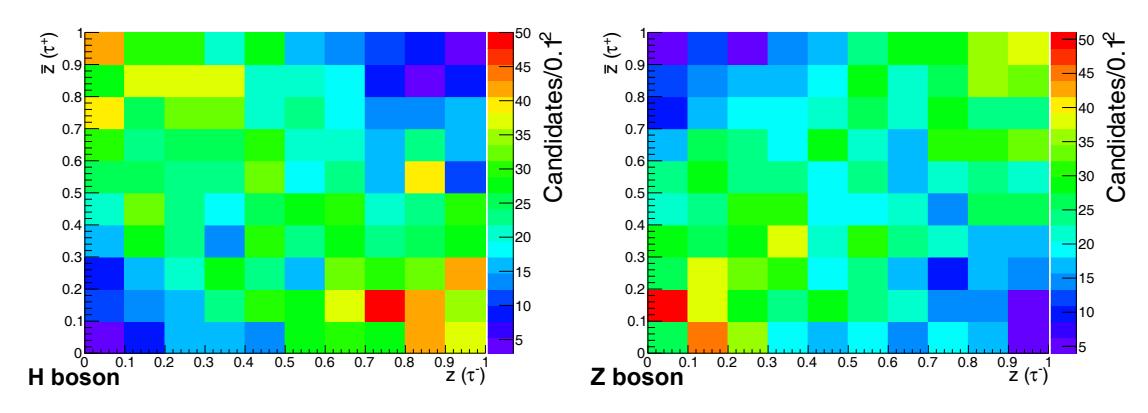
The simulated samples were analysed using ROOT [9]. By looking at the energy fractions of $τ$ leptons, $z = E_{vis}/E_{tot}$, an effect of polarisation in these events was observed, which provides basis for further development of the analysis algorithm and its implementation in the standard analysis chain of CMS.