
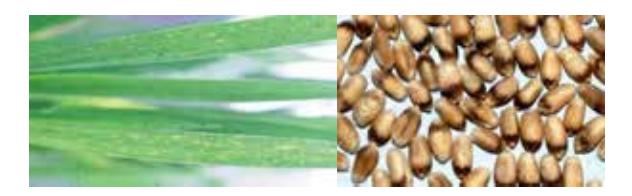
Pseudomonas syringae pathovars are known to cause diseases of cereals: pathovars atrofaciens has been associated with the basal glume blotch, pv. syringae with dieback and leaf blight, and pv. japonica – with black node and stripe blight. Meteorological conditions, particularly low temperature and high humidity, play the major role in manifestation and severity of bacterial diseases of cereals. Under favorable conditions these bacterial diseases may amount for up to 50% of yield loss. Usually regarded as being of low importance in comparison to fungal diseases, P. syringae has not been studied in cereal crops of Lithuania, and the atypical for fungal diseases leaf spots and glume discolorations are found rather frequently on cereals in the fields.
The disease affected plants were collected and isolation of P. syringae from damaged plant parts was attempted, with the resulting Pseudomonas isolates then classified by LOPAT tests: Levan production on sucrose medium, Kovacs' oxidase reaction, Pectolisity activity on potato slices or pectate gel, Arginine dihydrolase activity and hypersensitivity reacyion on Tobacco leaves.
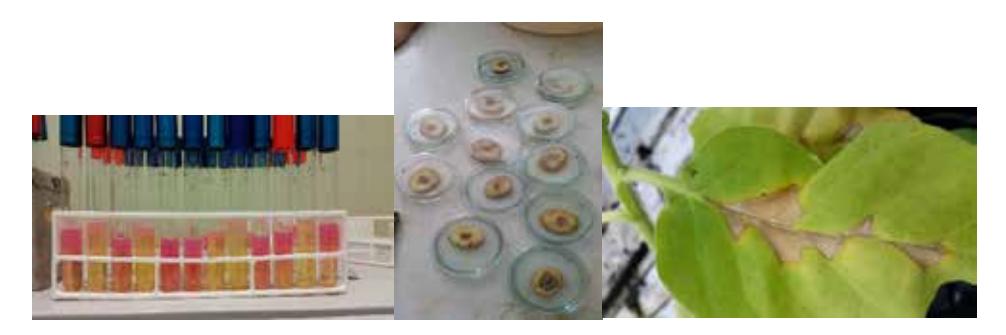
From grain and leaf distinguish 168 isolates, they stored -80°C to further research. There are currently performed biochemical studies with 149 (75% of spring wheat) bacterial isolates. The preliminary results indicate that approximately 14% of isolates are Pseudomonas spp. bacteria whose pathogenicity will be finally approved by the tobacco hypersensitivity test and infection of host plants.