
Superparamagnetic iron oxide-based nanoparticles are of great interest in medicine as magnetic resonance imaging (MRI) contrast agents, being a good alternative to traditional Gd-containing substances. The main requirements for such nanoparticles to be applicable in MRI are: small size and narrow size distribution, low toxicity and high magnetic properties, i.e. saturation magnetization value. Magnetic iron oxides with spinel structure ($\gamma$-Fe2O3 and Fe3O4) are most commonly used, however, their magnetic properties can still be improved by varying synthesis conditions and substituting some of the iron with other metal (Co, Ni, Mg, Zn etc.) ions, the arrangement of which also playing a big role [1, 2].
MgxZn1-xFe2O4 ($x = 0.25, 0.5, 0.7$) nanoparticles were synthesized using different methods: coprecipitation, spray pyrolysis and nitrate-citrate auto-combustion method, the last two being modified by introducing NaCl as inert component. Magnesium and zinc were chosen as doping ions due to relatively low toxicity and well-known ability to increase saturation magnetization of magnetite when placed in octahedral sites in spinel structure [3]. The phase and microstructure of the nanoparticles were studied with XRD and SEM/TEM analysis, and magnetic measurements were conducted at room and low (5-7 K) temperatures. The aim was to establish correlation between synthesis conditions, cation distribution, particle size and magnetic properties of the nanoparticles.
All the techniques used were found to produce single-phased spinel nanomaterials with the average particle size below 100 nm: 70-90 nm for nitrate-citrate, 20-40 nm for spray pyrolysis and 5-10 nm for coprecipitation method. The lattice constants for all methods used were found to be smaller than for bulk materials, with the increase with increasing zinc concentration, but differ for the same composition obtained by different methods. This can be explained by the difference in cation distribution because of the difference in temperatures and times of synthesis.
All the samples show no hysteresis behavior at room temperature which indicates their superparamagnetic state. At room temperature the highest saturation magnetization values for nitrate-citrate and coprecipitation methods were observed for Mg0.5Zn0.5Fe2O4 (22 and 33 emu/g, respectively). However, for spray pyrolysis method the highest saturation magnetization relates to Mg0.7Zn0.3Fe2O4 (26 emu/g).
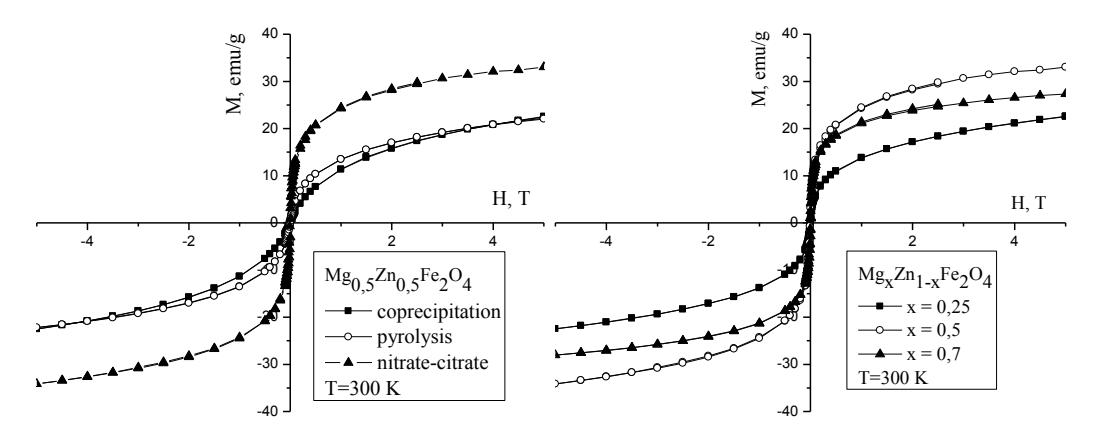
The inversion degrees for all samples were calculated and found to be around 0.93 for coprecipitation, 0.91 for spray pyrolysis and 0.89 for nitrate-citrate method, which corresponds well with the results of magnetic measurements – the lower the inversion degree, the higher is saturation magnetization. Annealing at high temperatures leads to the increase of saturation magnetization due to cation redistribution in spinel structure, but also results in additional aggregation of nanoparticles due to the sintering. To avoid agglomeration during annealing NaCl was used as a template for spray pyrolysis and nitrate-citrate methods, providing nanosized powders that are potentially applicable for MRI contrasting and other biomedical applications.