Katažyna Milto1, Magdalena Tworzydło1, Joanna Loch2, Krzysztof Lewiński2, Piotr Bonarek1
1 Faculty of Biochemistry, Biophysics and Biotechnology Department of Physical Biochemistry, Jagiellonian University, Poland
2 Faculty of Chemistry, Department of Crystal Chemistry and Crystal Physics, Jagiellonian University, Poland
Due to increasing level of prescription drug poisoning over the last decades, several techniques were developed to help to remove toxins from the human body. It has been reported that modified lipocalins called anticalins could be used as a carrier molecules for drug poisoning treatment. β-lactoglobulin, small lipocalin protein, is known to have high affinity to hydrophobic compounds. Additionally, it is water soluble, thermally stable and has high stability at low pH. Site-directed mutagenesis of the protein with such properties could make this protein alternative carrier molecule for different compounds.
Here we study structural stability of different β-lactoglobulin variants using urea-induced chemical denaturation. The process was monitored by circular dichroism and intrinsic tryptophan fluorescence spectroscopies. In several cases mutations made in the interior of binding site are significant to protein stability. Furthermore, by analyzing data acquired systematically over a wide range of pH, we are able to show changes in secondary structure fractions of different mutants.
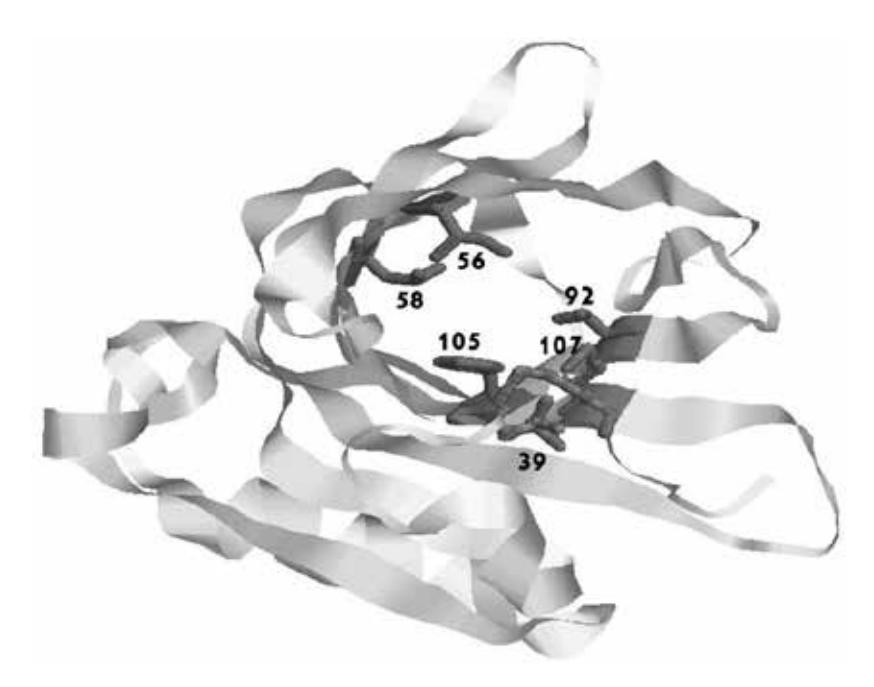
Fig. 1. β-lactoglobulin structure. Numbers indicate amino acid residues at which mutations were introduced.
Acknowledgments: This study was supported by the Polish National Science Centre, grant number: 2012/05/B/ST5/00278
[1] A. C. J. M. de Pont, Extracorporeal treatment of intoxications, Current Opinion in Critical Care13, 668-673 (2007).
[2] A. Skerra, Alternative binding proteins: Anticalins – harnessing the structural plasticity of the lipocalin ligand pocket to engineer novel binding activities, FEBS J.275, 2677-2683 (2008).
[3] A. Barbiroli, T. Beringhelli, F. Banomi et al., Bovine β-lactoglobulin acts as an acid-resistant drug carrier by exploiting its diverse binding regions, Biol. Chem.391, 21-32 (2010).