
Y3Al5O12 is commonly called yttrium aluminium garnet (YAG) and adopts the cubic garnet structure. Rare earth doped yttrium aluminium garnet has been thoroughly investigated for application in various fields, such as laser, scintillators, cathode ray tubes (CRT), field-emission displays (FEDs), plasmas display panels (PDPs,) and optical windows, due to its attractive optical property, outstanding chemical stability, low creep rate and high thermal resistance. Luminescent materials based on YAG are stable under conditions of high irradiation with an electron beam.When YAG is doped with Nd3+, it is reported that the near-infrared (NIR) laser output with high power and high slope efficiency were obtained in single crystals and polycrystalline transparent ceramic. The Nd3+- doped YAG is one of the most popular laser active materials [1-3].
In this work YAG garnetsamples doped with different amount of Nd3+ were prepared by sol-gel method. To our best knowledge, Nd:YAG garnets with various doping levels of europium have not been synthesized yet. Therefore, the main aim of this study was to fabricate these garnets and investigated their structural properties. The phase purity and crystallinity of synthesized samples were characterized by X-ray powder diffraction (XRD) analysis. The infrared spectroscopy (FTIR) was chosen as an additional tool to prove purity of garnets. The scanning electron microscope was used to study the surface morphology and microstructure of the obtained ceramic samples. The local structure of garnets was investigated by nuclear magnetic resonance spectroscopy (NMR 27Al).
It was confirmed from the XRD data that monophasic garnets can be easily synthesized at 1000 °C using the proposed sol-gel chemical approach. The results obtained by FTIR method are in a good agreement with XRD data and proves monophasic garnet structure compound existence. Surface behaviour between samples of different doping level was shown by SEM.27Al MAS NMR spectroscopy helped to investigate structural combination of garnets and allowed to compare dependence of peaks intensity on the concentration of dopant (Fig. 1).
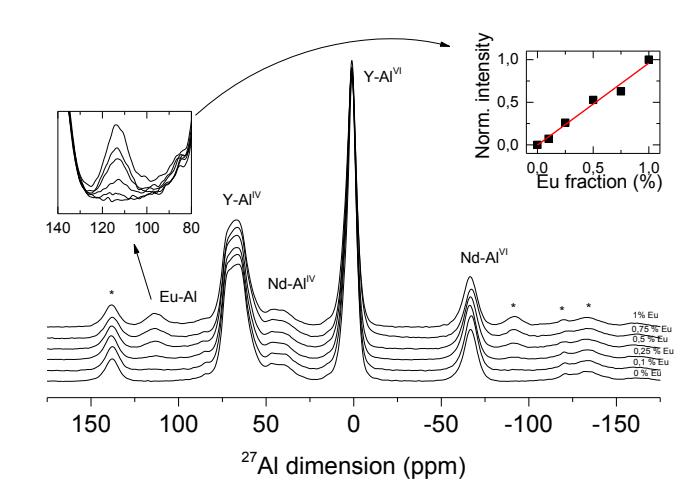
One of our aims was to analyze the influence of Eu3+in a garnet structure when concentration of neodymium ionswas permanent (0.1 molar part).This permanent amount of neodymium wasselected because ofthe sharpest and most intensive lines for all peakswith this doping level were observed. In Fig. 1 are seen the peaks which are attributed to the yttrium, neodymium and europium which are neighbours of tetrahedral and octahedral coordinated aluminium. The peaks attributed to Al-Eu increased proportionally with increasing doping level of europium.