
Currently, hypoxia-induced angiogenesis is a popular subject in cancer biology research, nevertheless, the molecular mechanisms and regulation of vascularization are still poorly understood. Several recent studies have suggested an association between hypermethylation of angiogenesis-related genes ADAMTS12 and FILIP1L and development of various types of cancer including prostate cancer (PCa) [1].
PCa is an oncological disease, which affects around 3000 men in Lithuania each year [2]. As with other solid tumors, the growth rate and progression of PCa is critically dependent on tumor angiogenesis. The development of novel diagnostic biomarkers' system could enable effective detection of early stages of prostate carcinogenesis and help to choose the most effective treatment.
The main purpose of our study was to analyze promoter methylation of the ADAMTS12 and FILIP1L genes in cancerous and non-cancerous prostate tissues (NPT) in order to identify potential epigenetic markers for PCa detection.
Global DNA methylation profiling by means of microarrays (Agilent Technologies) allowed the identification of angiogenesis-associated genes ADAMTS12 and FILIP1L, which were characterized by aberrant DNA methylation changes in tumors as compared to NPT. Promoter methylation status of selected genes was validated in 130 PCa and 35 NPT by methylation-specific PCR (MSP). Benign prostate hyperplasia (BPH) samples (N = 17) were used as an additional control group.
ADAMTS12 and FILIP1L promoter methylation was detected in 109 of 130 (84%) PCa samples for each gene. In NPT, methylation frequencies of ADAMTS12 and FILIP1L were 2 of 35 (6%) and 4 of 35 (11%), respectively. These results showed significant differences of the methylation frequency in PCa versus NPT (P < 0.001) or BPH (P < 0.001) cases (Fig. 1). According to clinical-pathological parameters of PCa cases, only methylation of ADAMTS12 gene promoter was significantly associated with biochemical disease recurrence (P = 0.041) or higher tumor (pT) stage (P = 0.045) and was close to significant (P = 0.057), in Gleason score 7 versus 6 cases. No statistically significant correlations were observed between ADAMTS12 or FILIP1L methylation status and prostate-specific antigen (PSA) level, tumor volume, prostate mass, or patients' age.
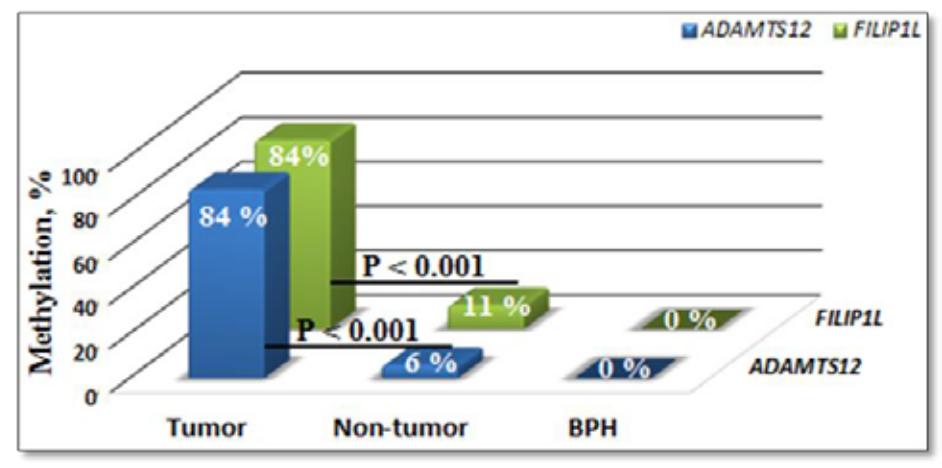
Our study revealed a significant difference in methylation frequencies of the ADAMTS12 and FILIP1L genes between prostate tumor and non-tumor tissues. Further quantitative research of genes' expression is required to evaluate reliability of these genes as potential biomarkers that are able to accurately distinguish indolent and aggressive PCa tumors.