
Monoclonal antibodies in XXI century became a valuable tool as a therapeutics, parts of immunodiagnostics and as a research tool in the field of proteomics [1]. Recombinant Fab fragments due to their ability of antigen binding in addition to a smaller size and bacterial expression possibility displaced monoclonal antibodies in some applications.
Despite all the advances of recombinant antibody expression in bacteria, a various problems with low expression levels and poor solubility of these proteins still exists. The method most often used to overcome the above is to express the protein of interest as a fusion tag, which increase solubility of fusion protein [2].
The promising candidate as a fusion tag is heme-binding domain of cytochrome b5. This hemeprotein possesses a great solubility and could be expressed in Escherichia coli in extremely high yields. Moreover, due to the Fe-protoporphyrin IX, coordinated with two histidines, cytochrome b5 has a stable red color with the absorbance maximum in the Soret region at 413 nm and two minor peaks in the Q-band region region at 532 nm and 559 nm. Thus, this protein could be used as a fusion and solubility tag in the same time, but there is no information about its applicability in the case of large proteins with quaternary structure in periplasmic space.
Using the hybridoma cell line 5G-H2, secreting monoclonal antibodies against cortisol, as a source of mRNA and cDNA respectively, VLCL and VHCH1 fragments of Fab domain were amplified by the polymerase chain reaction (PCR). Heme-binding domain of rat microsomal cytochrome b5 was fused to C-end of CH1 heavy chain domain with TEV-protease digestion site and His6-tag facilitating protein purification between them.
Molecular weight of the obtained fusion protein was confirmed by MALDI-TOF mass-spectrometry. It has been revealed that the most of the purified protein is in the dimeric state in solution with molecular weight well corresponding to the estimated. Binding activities of Fab-b5 fusion and hybridoma secreted immunoglobulin were measured by biolayer interferometry and ELISA. No significant difference between them was revealed.
Noteworthy, fusion protein yield was increased more than three fold in comparison with Fab fragment expression (from 2 mg/L to 7 mg/L in shake flasks cultivation). It confirms our assumption, that cytochrome b5 could enhance fusion protein expression in periplasmic space in addition to reported cytoplasmic expression enhancement.
Fusion Fab-b5 protein possesses a stable red color and characteristic absorbance spectrum with the maximum at 413 nm (Figure 1).
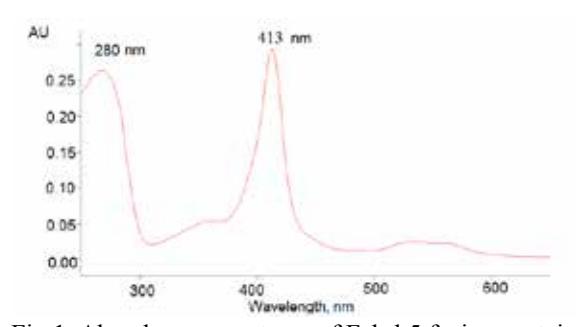
Due to this feature it became possible to distinguish fusion protein of interest in complex mixtures and control the process of recombinant proteins expression and purification in real-time. The high value of oxidized cytochrome b5 molecular extinction coefficient $\epsilon_{413}$ = 117 mM-1 cm-1 allows precise determination of protein concentration in broad ranges with the lower detection limit of pM concentrations even using the microvolume spectrophotometers. Moreover, difference spectrum measurement allows to minimize the contribution of other chromophores in the samples which could absorb in the same wavelength region. Cytochrome b5 fusion tag multiples recombinant antibody yield and doesn't affect antigen-binding properties.
The ability of cytochrome b5 fusion protein to change its absorbance maximum, depending on redox potential or folded state, could promote its usage as a marker of environmental state on the surface of or inside the nanoparticles (denaturating agents, redox potential) in the usage as a part of conjugated on its surface biomolecule. Moreover, it remains quantifiable, so it became possible to estimate bioorthogonal conjugation efficiency in simple and reliable way.