
Dye sensitized solar cells (DSSCs) recently attracted much scientific attention as an alternative light-to-electricity conversion solution. The multiple advantages include inexpensive and simple manufacturing process, device flexibility and transparency, as well as relatively high efficiency and stability. Until this day, the best performing DSSC devices reaching 11.5% efficiency were produced using ruthenium (RuII) complexes as a light harvesting material, however, limited resources and toxicity of ruthenium initiated the search of alternative materials [1]. Current DSSC studies are aiming at replacing ruthenium with more abundant analogs like iron, which is known to have similar electronic properties [2]. Unfortunately, the characteristic short lived excited states of the iron complexes does not allow to achieve high conversion efficiencies. Nevertheless, injection and recombination mechanisms shown in (Fig. 1) of interfacial electron transfer between metal complexes and the conduction band of titanium dioxide (TiO2) are still under debate.
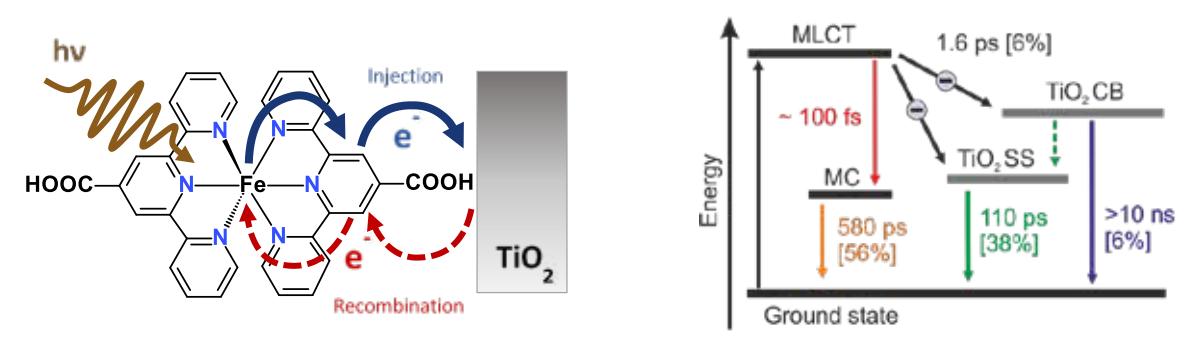
This work focused on investigation of electron transfer from extremely short-lived metal-to-ligand charge transfer (MLCT) states of iron (FeII) complex functionalized with terpyridine (tpy) ligands. The spectral and temporal excited state evolution was studied employing transient absorption technique, which allowed to investigate ultrafast processes occurring within timescales as short as femtoseconds. The global data analysis techniques allowed to separate and identify different states with a characteristic lifetime. Isolated iron complexes in dilute acetonitrile solutions exhibited two main excited state species: short-lived (<100 fs) MLCT state and long-lived metal-center (MC) states. Finally, the electron injection properties were investigated in systems, where FeII(tpy) complexes were sensitized to TiO2 nanostructured semiconductor. The observed multi-exponential excited state decay with lifetimes ranging from picoseconds to microseconds (see Fig. 1, right) suggested that fast initial electron transfer (1.6 ps) from MLCT state to the conduction band (CB) of TiO2 is followed by slower electron recombination. Our hypothesis was that electron recombination processes can either occur from the intra-band trap surface states (SS) with a lifetime of 110 ps or from the conduction band, resulting in much longer lifetime, which is also an indication of initial direct electron injection.
Although the observed injection efficiency in studied FeII(tpy) complexes was found to be low, this work contributes to the development of novel molecular iron based dyes to be employed in efficient DSSC devices. Most recent research is focusing on FeII complexes modified with N-heterocyclic carbenes (NHC) ligands, which were found to significantly prolong the MLCT lifetime leading to 92% electron injection efficiency [2,3].