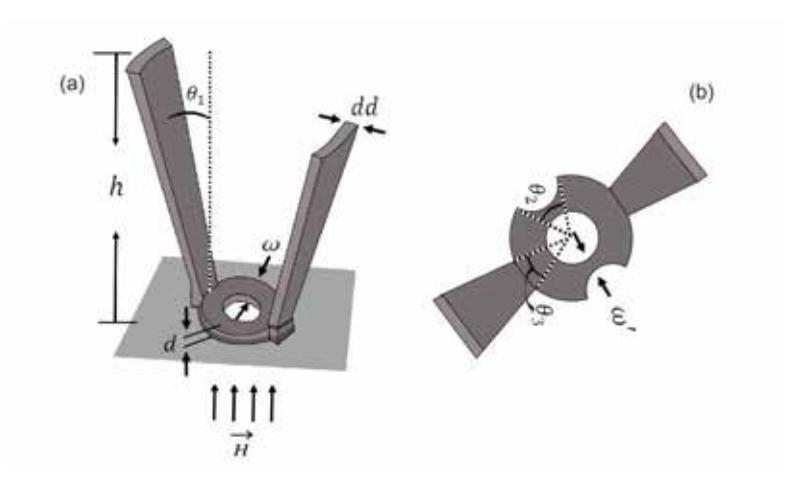
SQUID-on-tip (SOT) is the most sensitive magnetometry device to date [1]. We study the performance of such nano-sized SOT, as a function of its geometric parameters (see Fig.1a), in the presence of magnetic field, using the state-of-the-art three dimensional (3D) simulations within the phenomenological Ginzburg-Landau (GL) theory. Based on the observed behavior of the superconducting order parameter in the SOT, its magnitude (related to Cooper-pair density) and phase (related to circulating supercurrents), we propose engineering solutions at the nanoscale to improve the sensitivity of the device. For example, if we introduce the constriction in the arms of the SQUID loop (Fig.1b), we observe that the gradient of phase of the order parameter is largely enhanced in the constriction of the SOT in the Meissner and first vortex state, which is expected to facilitate the interference pattern of the critical current of the SOT and reduce the noise. We further discuss the other realizations of the SOT with engineered 3D shapes of the SQUID itself [2], and show the relation of those geometries to sensitivity to 3D magnetic field.