
Nowadays, when luminaires based on light – emitting diode (LED) technology are becoming more and more popular a lot of different standards were created to make the quality of luminaires better and prevent damage to users. For different uses of light sources (e.g. luminaires used on roads) there are several requirements (standards) for light distribution. Technique that is used to measure that distribution is called goniophotometry and the device is goniophotometer.
The main drawbacks of this method are that photogoniometers are quite expensive and requires huge room for big luminaires. Our task was to create an inexpensive goniophotometer which can be used in long rooms without essential loses of accuracy. Another task was to minimize the whole measurement time as much as possible.
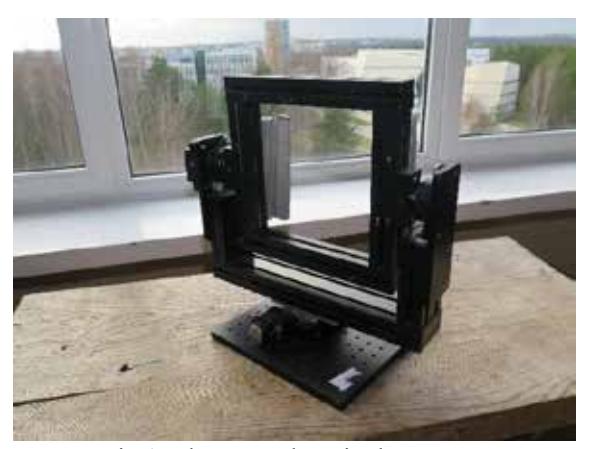
Goniophotometers usually have two rotating axes, which depend on the configuration used for measurement. There are three possible configurations (A, B and C) and for each special construction of photogoniometer is required[1]. Our created photogoniometer consists of the goniometer (fig 1.) and the luxmeter. As the goniometer rotates the luminaire, luxmeter measures the illuminance. At the end created software sorts out the date and returns a txt file that can be used in a special photometric programs to plot graphical distribution of light. It was decided to create a photogoniometer with two (B and C) configurations as they are most recently used. Rotation by x and y axes were introduced by high precision motors and rotation by z axis was simulated using mathematical formulas considering the shape of luminaire[2]. Software part was created using LabVIEW programing environment[3].
As a result, totally autonomous photogoniometer with B and C configuration measuring ability was created. Tests showed that the accuracy of measurement is high enough (maximum errors <1%). An integrated ability of automatic creation of IES files helped to decrease the time required for measurement.