
Atmospheric aerosols in range of PM1 (aerosol particles smaller than 1 μm) have adverse effects on human health and Earth's climate [1]. To reduce these effects it is necessary to possess the ability to trace atmospheric aerosol sources. Such ability is partially obtained by measuring $δ^{13}C$ values in aerosol particles because different organic materials (fossil fuel, biomass, etc.) have distinct $δ^{13}C$ values. The definition of $δ^{13}C$ is given in equation (1), ($^{13}C/^{12}C$) represents isotopic carbon ratio of standard and sample, respectively.
$$ \delta^{13}C = \left(\frac{\left(\frac{{}^{13}C}{{}^{12}C}\right)_{sample}}{\left(\frac{{}^{13}C}{{}^{12}C}\right)_{standard}} - 1\right) \times 1000 \%_{00}\tag{1} $$Aerosol samples were collected at Institute of Physics, Savanorių ave. 231, Vilnius, Lithuania, during period from 2014-10-22 to 2015-06-26. A high volume automatic air sampler and Whatman Q-MA quartz fiber filters were used for aerosol sample collection. Measurements of carbon concentration and $δ^{13}C$ values in aerosol samples were performed with EA-IRMS system (elemental analyzer - isotope ratio mass spectrometer). Meteorological data was obtained from NOAA Air Resources Laboratory archives [2].
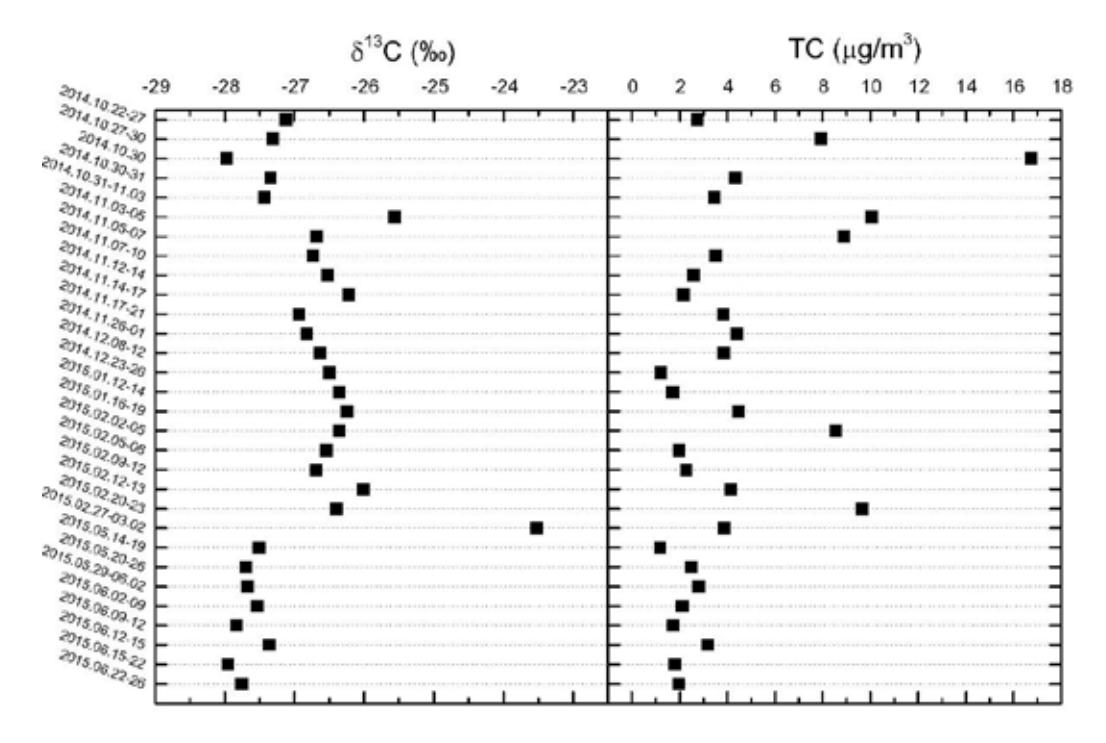
Stable isotope ratio mass spectrometry, combined with other analysis techniques, allows distinguishing carbon sources (biogenic from anthropogenic) in the atmosphere.