
High-power, few-cycle femtosecond laser sources require high energy, coherent phase pulses with broad spectra [1]. Continuum generation is widely used to obtain octave-spanning spectra by focusing the laser beam into one 3-5mm thick sapphire or YAG plate, but destructive nonlinear processes, which lead to pulse breakup, limit its energy to a few µJ.
Recently, a new method of generating high-energy continua was proposed, utilising several thin plates positioned one after the other near the beam focus [2]. For a beam focusing in a nonlinear medium, spectral broadening precedes multiple filamentation and damage, thus allowing a thin plate to broaden the spectrum of a high-energy pulse while avoiding unwanted spatial and temporal modulations [3].
We have assembled a multi-component continuum generator using 0.2mm thick sapphire (Al2O3) and 0.5mm thick fused silica (SiO2) plates. The plates were positioned at the Brewster's angle to minimise energy losses due to reflections. The generated continuum pulses were measured using visual and near-infrared spectrometers and the XFROG (Cross-corelation frequency resolved optical gating) pulse characterisation method.
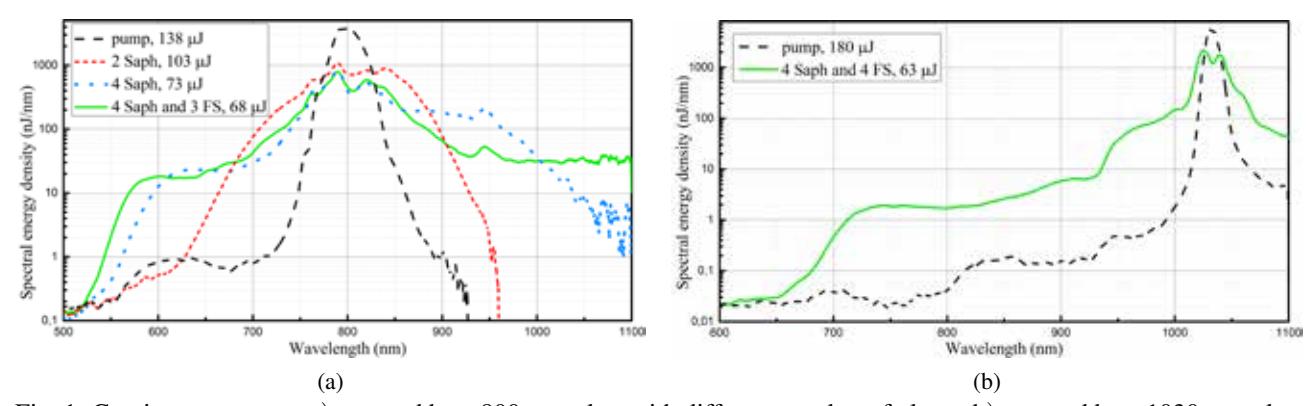
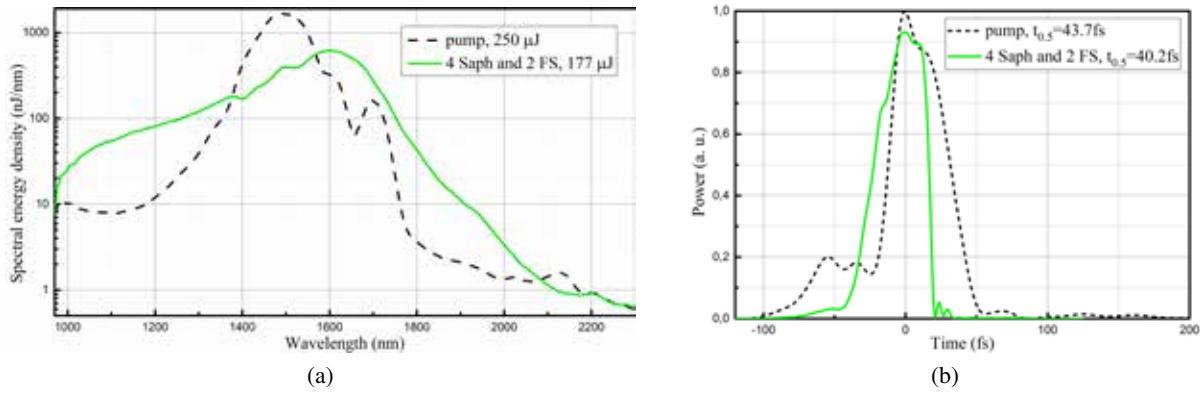
Using a 800nm, 138µJ pump pulse, a 68µJ continuum pulse with a wavelength range of 570-1100nm above the spectral energy density value of 10 nm/nJ was generated. Using a 1030nm, 180µJ pump pulse, a 63µJ continuum pulse with wavelengths extending from 715nm to at least 1100nm above 1 nJ/nm was produced. Using a 1500nm, 250µJ pump pulse, a 177µJ continuum pulse was achieved, with an octave-spanning wavelength range of 980-1910nm exceeding 10 nJ/nm, coherent spectral phase and a transform-limited length of 5 fs. In all the cases the resulting values of spectral energy density exceed a few hundres times those achieved by generating continua using only one 3-5mm thick plate.