SIMULATION OF HIGH DIFFRACTION EFFICIENCY TRANSMISSION GRATINGS
Lukas Stankevičius1, 2, Tomas Tamulevičius1, 2
1 Institute of Material Science, Kaunas University of Technology
2 Physics Department, Kaunas University of Technology
Many research applications requires high intensity ultrashort laser pulses. Usually they are achieved employing chirped pulse amplification [1] and this requires nearly unit diffraction efficiency (DE = 100%) diffraction gratings. In this work, high efficiency diffraction grating for transmitted light diffraction was simulated.
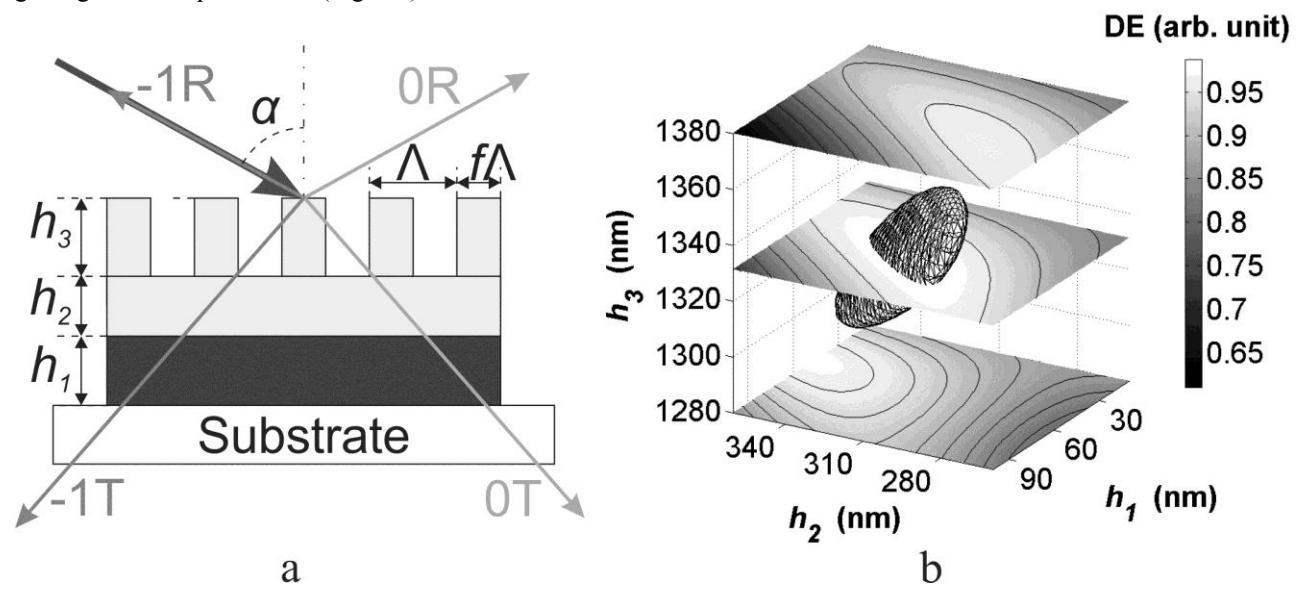
Simulation was performed employing GSolverV52 software based on rigorous coupled-wave analysis. Two materials, one of high refractive index (Nb2O5) and other of low (SiO2) were forming the antireflection coating and grating layer. Optimization was done for Yb:KGW laser with central wavelength of 1030 nm. Littrow configuration and TE (Transverse Electric) polarization case was simulated. Diffraction efficiency of -1T order was optimized varying grating structure parameters (Fig. 1 a).
Fig. 1. (a) Simulation model. Light is of TE polarization and α = 61° incidence angle (Littrow). Structure is on fused silica substrate. Grating has filling factor f = 0.5 and period Λ = 588 nm. h1, h2 and h3 corresponds to thickness of shown layers. (b) Simulation diffraction efficiency dependence on structure parameters h1, h2 and h3. Greyscale shows DE value for each point. Ellipse shape in the middle of the graph is closed surface of greater than 0.98 diffraction efficiency values.
It was demonstrated that the highest transmitted light diffraction efficiency is 0.986 for proposed structure parameters h1=60.2 nm, h2=315.5 nm and h3=1331.3 nm. It is noted that grating structure utilizes antireflective properties of two different refractive index layers combination, as they assures 0.999 (0T) at h1=72.3 nm and h2=258.4 nm without presence of the grating.
Acknowledgments: We would like to acknowledge dr. L. Giniūnas (Light Conversion), dr. R. Drazdys and dr. K. Juškevičius (Optida) for consultations and information about dielectric coatings. Lukas Stankevičius acknowledge support by project "Promotion of Student Scientific Activities" (VP1-3.1-ŠMM-01-V-02-003) from the Research Council of Lithuania. This project is funded by the Republic of Lithuania and European Social Fund under the 2007-2013 Human Resources Development Operational Programme's priority 3.
[1] A. Dubietis, G. Jonušauskas, A. Piskarskas, Powerful femtosecond pulse generation by chirped and stretched pulse parametric amplification in BBO crystal, Optics Communications, 88(4-6), 1992, pp 437-440