
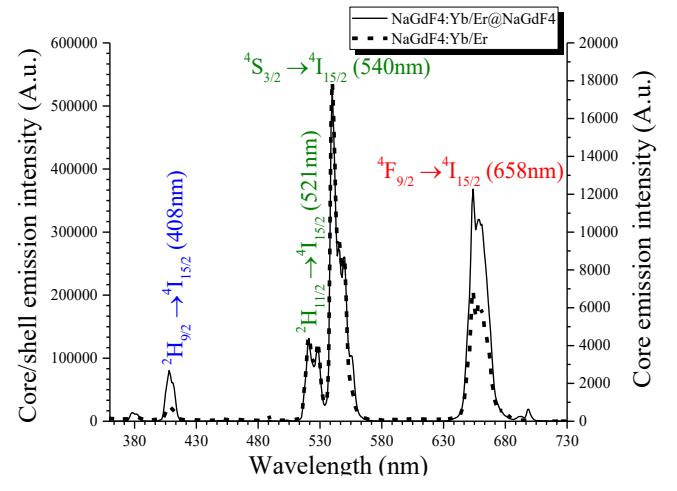
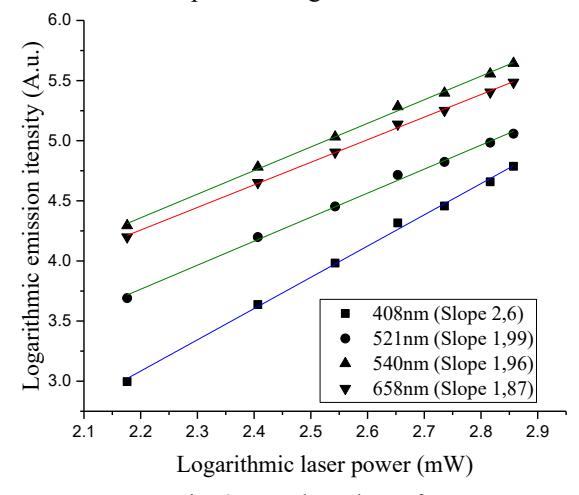
Upconversion photoluminescence (PL) refers to non-linear optical processes facilitated by multi-absorption of two or more pump photons to convert lower energy photons into higher energy ones. Upconverting nanoparticles (UCNPs) are a promising new generation of imaging agents capable of working as theranostic agents [1]. Compared to traditional photoluminescence agents they offer many advantages, for instance working in optical transparency window (~650-1350nm), deeper light penetration, reduced photodamage of biological tissues due to NIR excitation, narrow bandwidths for multiplexed imaging, possibility to add second imaging source such as MRI. However, current multimodal UCNPs are still not widely used in medical environment because of their low photoluminescence intensity and poor contrast in MRI. In our study we have designed and synthesized hexagonal phase NaGdF4:Yb/Er@NaGdF4 core-shell structure nanoparticles with PL, MRI and drug carrying capabilities. X-ray diffraction, Scanning Electron Microscopy, PL spectroscopy were used to characterize UCNPs. Nanoparticles were phase transferred to water after ligand-exchange with TWEEN 80 in order to make them hydrophilic. Upon 980nm excitation nanoparticles exhibit sharp emission peaks which can be attributed to 2H9/2 → 4I15/2, 2H11/2 → 4I15/2, 4S3/2 → 4I15/2, 4F9/2 → 4I15/2 transitions of Er3+ ions. These peaks correspond to respective blue (408nm), green (521nm, 540nm) and red emissions (658nm). It was shown that PL intensity increased about 32 times by growing an optically inert NaGdF4 layer around NaGdF4:Yb/Er nanoparticles (Figure 1). To estimate how many photons participated in each energy transition UCNPs intensities were measured as a function of the laser pump power. For the upconversion process, the number of photons required to populate the upper emitting level is described by the relation IUCNP~InNIR where IUCNP is the fluorescence intensity, INIR is the pump laser intensity and n is the number of pump photons required. Slopes (n) of the main peaks at 408, 521, 540 and 658nm were 2.6, 1.99, 1.96, 1.87 respectively, suggesting three-photon process at 408nm, and two-photon processes for the remaining wavelengths (Figure 2). Additionally, colloidal stability of UCNPs in different biological media (DMEM, various pH) were investigated. No significant decrease in emission intensity was observed during one month. We have also obtained that NaGdF4:Yb/Er@NaGdF4 UCNPs are photostable and do not degrade even when exposed to high doses of irradiation.
Lastly, cell viability assay XTT was performed to measure cellular metabolic activity (with Mda-mb-231, Mcf-7 cancer cell lines) after 24 hours treatment with different concentration of UCNPs. A toxic effect of UCNPs was observed at a concentration of higher then 33μg/ml. Results of our study have shown that core/shell NaGdF4:Yb/Er@NaGdF4 nanoparticles may be effective multimodal theranostic agents in early cancer diagnostics. This work was supported by grant No.MIP-030/2014 from the Research Council of Lithuania.