
Hydrogen bonds play a crucial role in chemistry and biology. Numerous experimental and theoretical studies have been devoted to the explanation of the structures and the energetics of hydrogen bonds [1-4]. Water is the prototypical molecule which forms hydrogen bonds easily with most other molecules, including itself. The absorption frequencies of a single water molecule in the vapor phase are well known. In contrast the vibration spectra of liquid water is much more difficult to interpret, since in water a single molecule can be associated with other molecules through hydrogen bond formation. The neighboring molecules change the absorption frequencies of the isolated molecule and also introduce new frequencies due to intermolecular interactions. Since the normal modes of vibration of liquid water are generally unknown the absorption bands are difficult to assign. Besides its fundamental importance in chemical and biological processes, water dimer is the simplest model system for intermolecular interactions. Therefore it has been the subject of numerous experimental and theoretical studies. As often happens when a variety of research groups examine the same molecular system using a wide assortment of ab initio techniques, the system evolves into a testbed for new methods. Among these systems relatively few generate sustained interest over a long enough period of time. However, the H2O-H2O system certainly falls into this category.
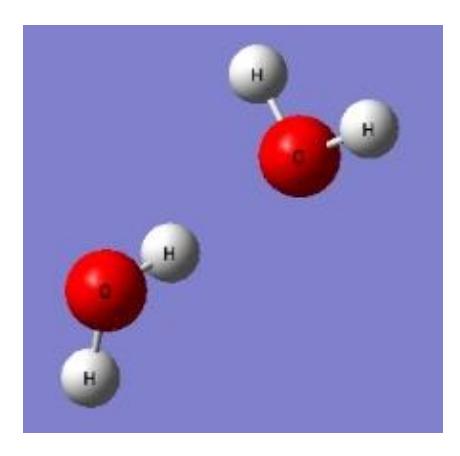
In present research structure of the water dimer was calculated using B3LYP/cc-pVTZ, B3LYP/acc-pVQZ, MP2/cc-pVTZ and MP4/cc-pVTZ levels of theory. Equilibrium geometry of the water dimer presented in Fig.1.
As known, vibrations of the hydroxyl groups involved in the hydrogen bond formation is strongly anharmonic. Therefore, vibrational spectra of the water dimer were calculated both in harmonic and anharmonic approximations for some levels of theory. Besides, multidimensional potential energy surfaces, associated with the motion of the H atom of the hydrogen bridge were computed, and their form confirm the suggestion about the presence of anharmonicity. In order to establish frequencies of the H-bonded hydroxyl group vibrations, the multidimensional Schrödinger equations were solved numerically using Fourier and DVR methods[5,6].