
Determining the Higgs boson properties is of high importance in particle physics today. Since the discovery of the Higgs boson it was shown that this particle interacts and decays in many ways predicted by the Standard Model as summarized in [1]. However, more studies are required to confirm that the discovered particle has the properties matching to those predicted by the Standard Model. The study of the fermionic Higgs boson decays provides information about the Higgs boson coupling to the fermions.
For this analysis we selected the Higgs boson decay channel $h \to \tau^+ \tau^-$ with $\tau$ leptons decaying each into muon and neutrinos. The selected Higgs boson production mechanism is Higgs boson production in association with the W boson. Therefore, the most complicated background process to discriminate is the Z boson production with the W boson where the signature is very similar: $Z \to \tau^+ \tau^-$ with $\tau$ leptons decaying each into muon and neutrinos. The W boson in both processes decays into muon and neutrino. The goal of this analysis was to find possible discriminating variables for these two processes. The analysis was performed having two levels of events. First level was the generated level. Events at this level were obtained using Monte Carlo generator (PYTHIA 8.2, described in [2]). The second level in the analysis was the reconstructed level. The generated events were reconstructed with CMS software (CMSSW).
In particle physics, the invariant mass $m_0$ is equal to the mass in the rest frame of the particle. It can be calculated by the particle's energy E and it's momentum p measured in any frame, by the energy-momentum relation:
$$m_0^2 c^2 = \left(\frac{E}{c}\right)^2 - ||\mathbf{p}||^2 \tag{1}$$The invariant mass $m_0$ in equation (1) remains the same in every frame. It can be reconstructed from the decay products of the particle. However, $\tau$ leptons cannot be fully reconstructed in the detector. We can only detect their visible decay products - muons. The neutrinos from the $\tau^- \to \mu^- \nu_\tau \bar{\nu}_\mu$ and $\tau^+ \to \mu^+ \bar{\nu}_\tau \nu_\mu$ decays are not measured.
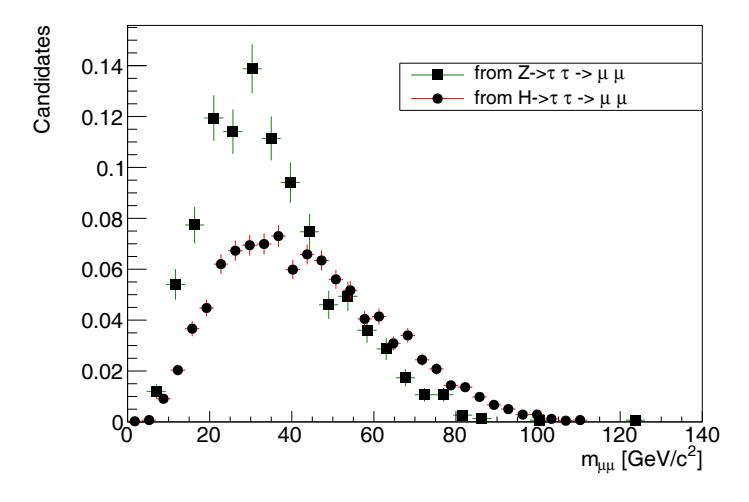
In the Fig. 1 we can see that there is a difference between reconstructed invariant mass from muon pair for Wh and WZ processes. Therefore, the reconstructed invariant mass is one of the discriminants between these two processes. We also found differences between the Wh and WZ processes in the missing transverse energy and in the various angles between the detected muons. These discriminants and the correlations between them will provide useful information for multivariate analysis using a trained neural network to analyze the data in proton-proton collisions at 13 TeV detected during the LHC Run II.