
Lithium orthosilicate (Li4SiO4) pebbles with addition of titanium dioxide (TiO2) are suggested as an alternative tritium breeding ceramic for the fusion reactors. Under exploitation conditions, the Li4SiO4 pebbles will be subjected to neutron and ionizing irradiation, high temperature and magnetic field. The radiolysis will take place in the Li4SiO4 pebbles where radiation-induced defects (RD) and radiolysis products (RP) can form and accumulate. The aim of this work is to analyse the formation and accumulation of RD and RP in the Li4SiO4 pebbles with different content of TiO2.
The Li4SiO4 pebbles with addition of TiO2 were irradiated with accelerated electrons ($E=5$ MeV) up to 5 GGy absorbed dose at 300-730 K in dry argon atmosphere. The formation, accumulation and annihilation of paramagnetic RD and RP were analysed by electron spin resonance (ESR) spectroscopy.
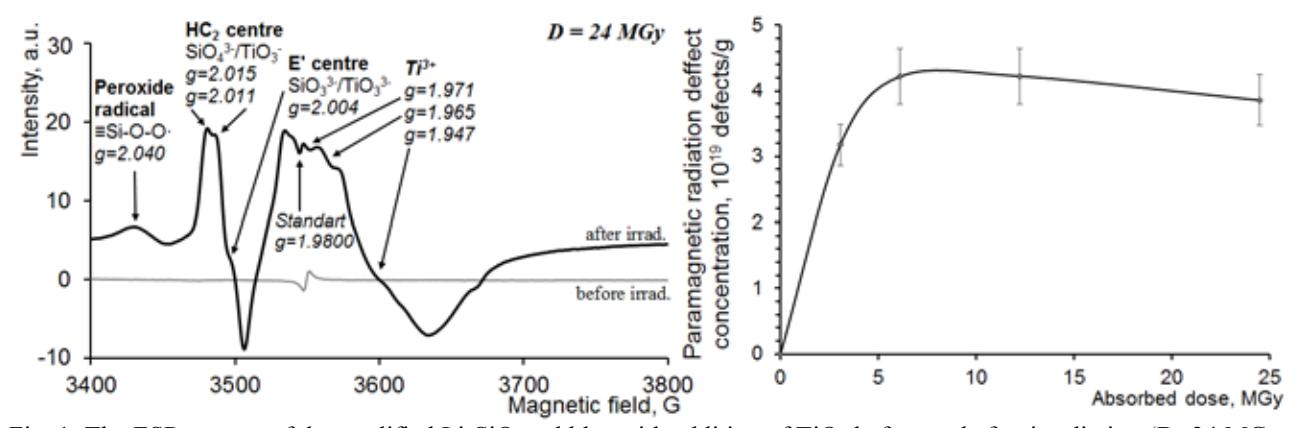
Using ESR spectroscopy, the formation and accumulation of paramagnetic RD in the Li4SiO4 pebbles with addition of TiO2 was detected (Fig. 1, left). The total concentration of paramagnetic RD was calculated using double integration method of the first derivative ESR signals and by comparison with the standard signal (Fig. 1, right). In comparison with previous researches [1], it was shown that the Li4SiO4 pebbles with addition of TiO2 have a good radiation stability and the initial radiation chemical yield (G) is below 0.5 defects per 100 eV. It was determined that up to 95% of accumulated paramagnetic RD annihilated before reaching 650 K.