PHOTOELECTRIC PROPERTIES MEASUREMENT OF THIN FILM HYDROGENATED AMORPHOUS SILICON WITH VANADIUM PENTOXIDE WINDOW LAYER
Augustas Nekrošius1, Vaidotas Kažukauskas1
1 Semiconductor Physics Department and Institute of Applied Research, Vilnius University, Saulėtekio al. 9/3, Vilnius LT-10222, Lithuania
Hydrogenated amorphous silicon (a-Si:H) has a sufficiently low amount of defects to be used within devices such as solar photovoltaic cells, particularly in the protocrystalline growth regime. However, hydrogenation is associated with light-induced degradation of the material, termed the Staebler–Wronski effect.
pin-type hydrogenated amorphous silicon (a-Si:H) solar cells are potential renewable solar energy sources due to their low fabrication cost. On the other hand, the device efficiency of a-Si:H solar cells is still relatively low compared to poly-Si solar cells. One method of improving device performances in a-Si:H solar cells is to insert a transition metal oxide, such as vanadium pentoxide (V2O5-x) window layer.
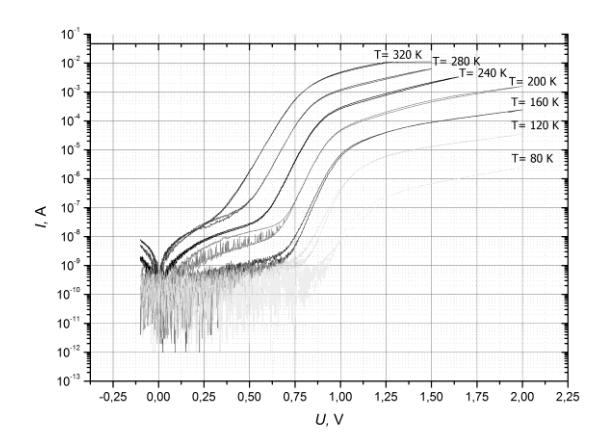
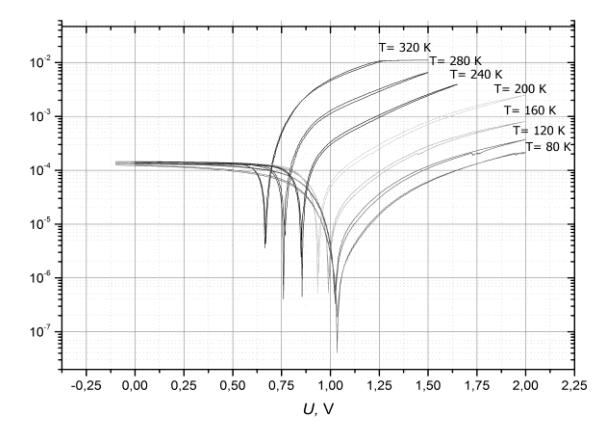
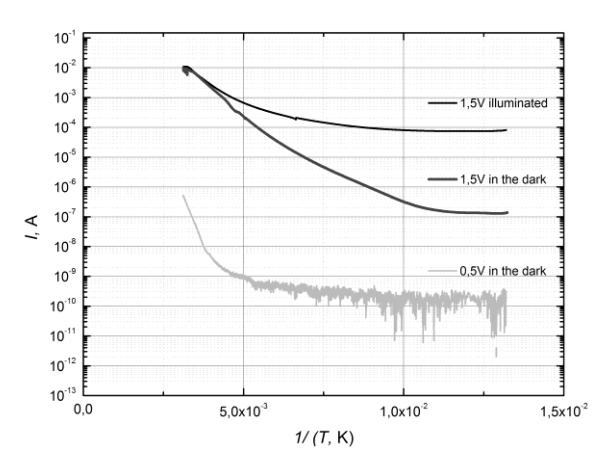
In order to determine the difference in performance and capabilities of such solar cells I-V characteristics and temperature dependencies of electrical dark and photo-conductivity were measured in the temperature range from 80 K to 320 K.
Fig. 1. I-V characteristics of electrical dark conductivity.
Fig. 2. I-V characteristics of photo-conductivity.
Fig. 3. Temperature dependencies of electrical dark and photo-conductivity.
Further measurements must be done to confirm the systematic reiteration of measurements for reliable data that could be applied in theoretical calculations and conclusions.
[1] R.W. Collins, et al., "Evolution of microstructure and phase in amorphous, protocrystalline, and microcrystalline silicon studied by real time spectroscopic ellipsometry", Solar Energy Materials and Solar Cells, 78(1-4), pp. 143-180, 2003.
[2] S. Y. Myong, S. W. Kwon, J. H. Kwak, K. S. Lim, J. M. Pearce, and M. Konagai, "Good stability of protocrystalline silicon multilayer solar cells against light irradiation originating from vertically regular distribution of isolated nano-sized silicon grains", 4th World Conference on Photovoltaic Energy Conversion Proceedings, p. 492, 2006.
[3] C. R. Wronski, et al., "Intrinsic and Light Induced Gap States in a-Si:H Materials and Solar Cells - Effects of Microstructure", Thin Solid Films, 451-452 pp. 470-475, 2004