
There is a growing interest in elastic and transparent materials, capable of conducting current, used for example as electrodes in organic solar cells, or touch screens as ITO replacements. Lightweight and nontoxic carbon nanomaterials, like graphene [1], or carbon nanotubes seem be suitable for those purposes [2]. What is more, some of nano carbon materials electromagnetic wave attenuation properties may lead to their utilization as EMI (electromagnetic interference) shields, or eye protection [3].
Although carbon nanomaterials have been thoroughly studied in many fields of physics and chemistry, we have noticed a lack of a comparative study of those materials regarding their attenuation of electromagnetic waves. Such work is vital in understanding possible applications of aforementioned nanostructures.
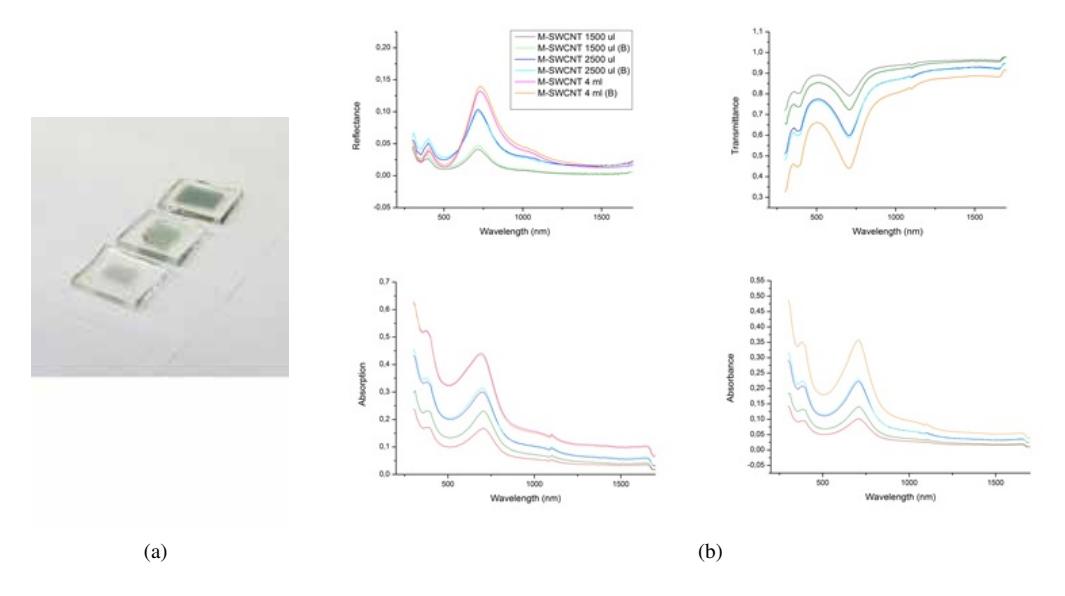
We present a complex review on optical properties of selected carbon nanomaterials. Samples transmittance, reflectance and as a result – absorption and absorbance, are measured in the visible light spectrum as well as IR and UV (300 -1700nm), using an integrating sphere. Materials used in this study include graphene (both mono- and multilayer), GO (graphene oxide), rGO (reduced graphene oxide) and carbon nanotubes – semiconducting, metallic and mixed. Those materials are further processed to recieve homogenous thin films using various methods like vacuum filtration, drop-casting or electrochemical delamination. The study includes measuring those nanocomposites in respect to their thickness (from 50nm to 1μm).