
All-fiber ultrashort-pulse lasers are becoming more and more popular not only for their excellent performance, which is now comparable with solid state lasers, but also because of complicated and fascinating nonlinear dynamics that take place within the cavity. All-normal-dispersion cavity fiber lasers are especially interesting because during propagation through the cavity laser pulses become highly chirped and, thus, maximum pulse intensity can reach high levels without the risk of the pulse distortion. This allows achieving pulse energies in nanojoule range with compressed pulse duration below 200 fs. In this paper we will be focused on the pulse propagation in the all-normal dispersion cavity where nonlinear phase accumulation together with normal GDD stretches the pulse [1]. The pulse formation process in such a cavity is known as a dissipative soliton regime. The pulse generation and shaping mechanism in such regime depends not only on the saturable absorber but also on the spectral filtration of the pulse. The narrow band-pass spectral filter cuts off the wings of highly chirped pulse inside the cavity and effectively shortens the pulse in time domain [2]. The spectral filter compensates temporal pulse broadening effect that appears during propagation in the normal dispersion material. We showed experimentally that by using different spectral shapes of the bandpass filter inside the all-fiber cavity one can manipulate to some extent the spectral intensity and spectral phase components of the pulse. Spectral filtration determines the initial pulse temporal envelope before further propagation in the all-fiber cavity.
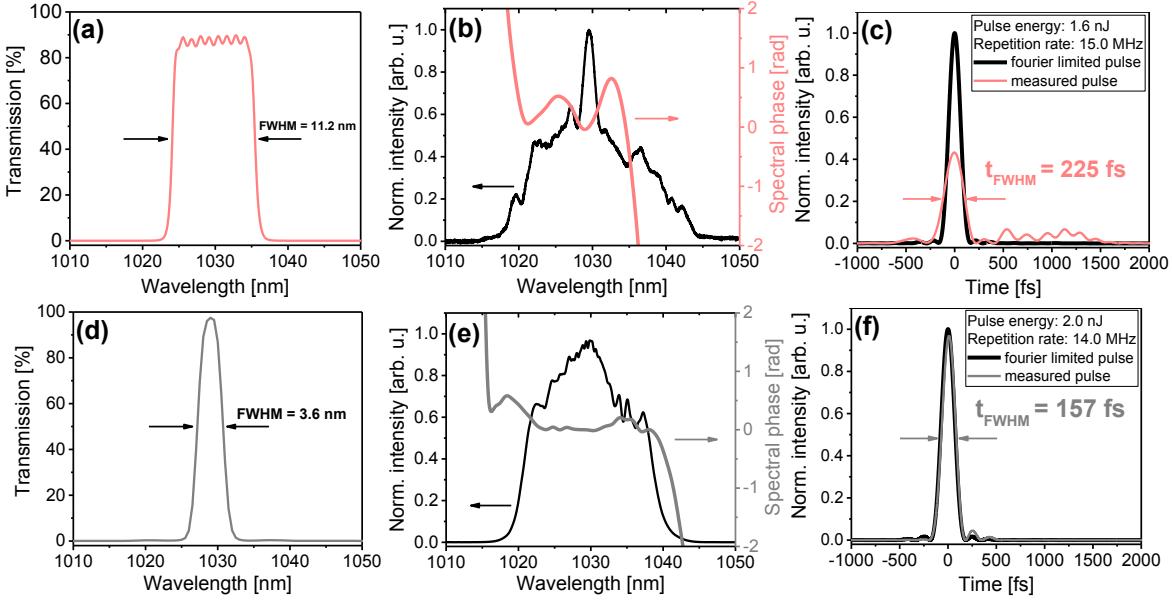
In Fig. 1 we present parameters of pulses from two all-fiber oscillators configurations with different spectral filter used inside the cavity. The (a),(b),(c) graphs present performance of the 15.0 MHz oscillator which delivered 1.6 nJ pulses compressed down to 225 fs [3]. The cavity works with 11.2 nm FWHM super-gaussian spectral filter (a). The (d),(e),(f) graphs show parameters of 2.0 nJ, 157 fs high-quality pulses generated from the oscillator working at 14.0 MHz repetition rate with the gaussian shaped 3.6 nm FWHM spectral filter (d). The results showed that the gaussian profile of spectral filtration (without steep edges) helped to avoid excessive nonlinear phase accumulation. In the configuration with gaussian filter the nonlinear phase of the pulse gained during the propagation in the cavity was compensated by means of standard grating compressor. The pulses were compressed close to their fourier-limited duration. The experimental results are supported by extensive numerical simulations of spectral filtration shape influence on the pulse temporal envelope in the all-fiber cavity.