
The application of dehydrogenases for bioconversion of organic compounds is very attractive due to their appropriate catalytic activity and substrate specificity. For successful use of dehydrogenases in bioconversion systems the effective regeneration in situ schemes of their expensive cofactors must be created [1,2,3].
Common mediator-dependent conjugated biocatalytical systems consist of a mediator reducing and a mediator oxidizing steps (Fig.1).
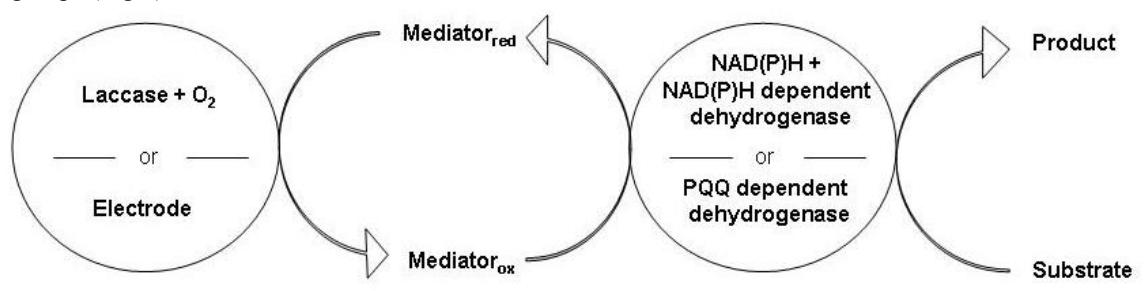
The task of our investigation is to develop the possibility of use of a diazo compounds - 4-hydroxy-3,5-dimethoxybenzaldehydeazine (syringaldazine) and N,N'-dimethyl-4,4'-azopyridinium (MAZP), as electron transfer mediators for conjugated biocatalytical schemes.
Both the chosen mediators are of moderate redox potential and their redox conversion proceeds with participation of two electrons and two protons [4,5].
The reactivity of mediator and NAD(P)H is one of the factors defining the efficiency of the mediator in the cofactor regeneration process. The calculated bimolecular constant values ($k_b$) of cross reaction of oxidized syringaldazineand NAD(P)H are $(1.0\pm0.1)\times10^4$ M-1s-1 for NADH and $(1.0\pm0.2)\times10^4$ M-1s-1 for NAD(P)H at pH 8.0, whereas the $k_b$ value of MAZP and NADH is $(2.2\pm0.1)\times10^5$ M-1s-1 at pH 7.2. This is a very high value comparing to other compounds used as mediators for NADH oxidation.
The activity of laccases from Didymocrea sp. (DsL) and Trichaptum abietinum (TaL) with syringaldazine as a substrate was investigated at different pH. These enzymes showed different pH profiles toward syringaldazine. DsL showed a maximum activity at pH 8.0 that is unusual for fungal laccases. The maximal activity of TaL was observed at pH 5.5. The rate constant of syringaldazine reactivity with DsL is $(4.2\pm0.5)\times10^4$ M-1s-1, at pH 8.0. Differently than syringaldazine the reactivity of MAZP with laccase was low. The rate constant of MAZP reduced form reactivity with laccase from Polyporus pinsitus (PpL) is $(5.4\pm0.3)\times10^3$ M-1s-1 at pH 5.5.
The efficiency of mediator in conjugated scheme was investigated using DsL laccase as oxidized enzyme and oxygen as a final electron acceptor in the case of syringaldazine, whereas in the case of MAZP mediator was oxidized at the electrode. In the case of laccase total turnover numbers (TTNs) was determined by the product of ethanol oxidation - acetaldehyde amount, whereas in the case of MAZP - by the number of electrons in the electrolysis. TTNs for cofactor using syringaldazine and MAZP as mediators are 4 and 8.5, respectively. The calculated TTNs were not high because of the enzyme (NAD+-dependent alcohol dehydrogenase) inactivation and of the leakage of acetaldehyde, which is known as volatile and reactive compound.