
1,8-Naphthalimide derivatives are widely used for various applications. They were applied in such fields as laser active media, anticancer agents, analgesics in medicine, fluorescent markers in biology, fluorescence switchers and sensors, as electron-transporting and emitting materials in light emitting diodes [1, 2]. Derivatives of 1,8-naphthalimide compounds generally have high electron affinity due to the existence of an electron-deficient center and can be easily functionalized. Meanwhile dimethylaminebenzene (DMAB) moieties are electron-rich and mostly known for they unusual dual fluorescence [3].
In this work we investigate photophysical properties of donor-acceptor systems composed of 1,8-naphthalimide (NI) with dimethylaminebenzene (DMAB) moiety linked through single C-C (NI1) and acetylene (NI2) bonds in the 4th position. The naphthalimide derivatives were synthesized by D. Gudeika from prof. J. V. Gražulevičius group at Kaunas University of Technology (KTU).
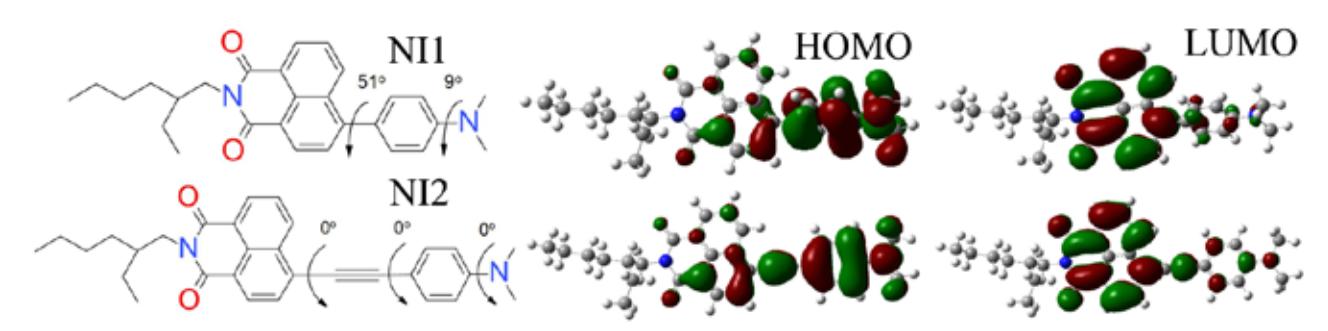
Theoretical DFT calculations revealed that in the ground state NI1 compound shows rotation angle of 51° between naphtalimide and DMAB and 9° dihedral angle between benzene ring and dimethylamine, while NI2 possess flat configuration (Fig. 1.). For both molecules the electron density is distributed between naphtalimide and DMAB moieties in ground state. The electron density for HOMO is mostly localized in DMAB moieties for both compounds. In the excited state both complexes rotate up to 90° and the charge density is localized on the naphthalimide moieties, thus showing twisted internal charge transfer (TICT). When molecules twist perpendicular oscillator strength for the lowest energy transitions becomes 0, hence restricting transitions.
The solvatochromic investigation of absorption and fluorescence spectra in medium of various polarity (0–3.96 D) approved a formation of twisted internal charge transfer states. Absorption spectra shows a broad structureless band at around 425 nm typical to charge transfer state. Also a small peak is observed at 350 nm typical for 1,8-naphthalimide locally excited (LE) state. The TICT state of NI2 absorbs twice as much light as NI1 supporting theoretical oscillator strength calculations. The color of fluorescence varies in the visible range of spectrum from 470 nm in non-polar solvent to 770 nm in the most polar solvent while the quantum yield is quenched from 82% to 0.3% respectively which is consistent with theoretical calculations. Strong fluorescence dependency on solvent polarity can be applied in medium polarity sensors.
Further investigation showed that some specific cations (such as Hg2+) can change photophysical properties drastically. Absorption and fluorescence typical for TICT is quenched meanwhile peaks at 350 nm for absorption and 405 nm for fluorescence emerge. New bands exhibit similar properties in both molecules which are typical for 1,8-naphthalimide locally excited state. This means that cations interact with dimethylamine (DMA) moiety and disables its electron-donating properties prohibiting twisted internal charge transfer. This effect can be used to sensitively detect specific cations.