
Nowadays semiconductor laser diodes (LDs) are widely used in the high-speed optical communication and data transmission systems. Researches on reliability of laser diodes can help to avoid system breakdowns due to LD failure. Compared to the other methods, low-frequency noise spectroscopy is non-destructive and very sensitive diagnostic tool for optoelectronic device quality evaluation and identification of nature of the degradation sources [1, 2]. Understanding of physical processes that occur in the vicinity of the lasing threshold requires a special attention, too [3].
The investigated devices are multiple-quantum-well distributed feedback (DFB) InGaAsP 250 μm channel length laser diodes radiating at 1.55 μm. They were fabricated for operation as light source in optical communication systems.
Spectra of optical and electrical fluctuations are $1/f^{\alpha}$-type. The cross-correlation coefficient between optical and electrical fluctuations is very sensitive to the LDs quality: for some samples at the lasing threshold there is negative correlation range while for others – only positive. Leakage current channels at the active region interface leads to the negatively correlated fluctuations in LD and it is shown that such LDs are unreliable and tend to degrade. A positive cross-correlation coefficient at currents above the threshold is considered as typical for the good quality DFB LDs [1].
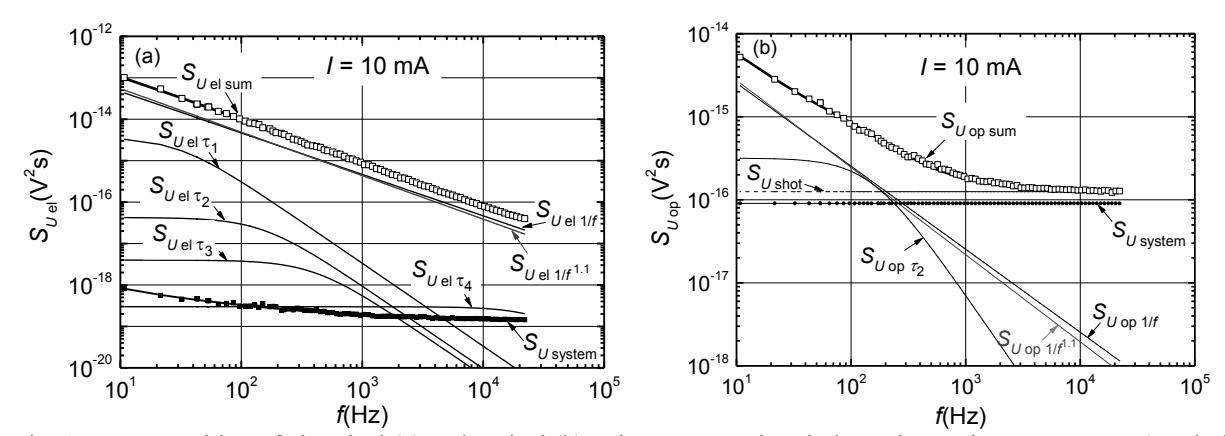
The power spectral density of either electrical or optical fluctuations of LD at low frequencies can be presented as a sum of independent components of 1/f, $1/f^{\alpha}$, Lorentzian type (with characteristic time $\tau$) and shot noise. Such presentation means that noise sources are statistically independent. An example is presented in Fig. 1. Actually, not all electrical low frequency fluctuations completely correlate with the optical ones (e. g., contact noise or noises in the passive layers of LD do not correlate) [2]. Total and correlated parts of the variance of current fluctuation are approximately proportional to the forward current in LED mode. Radiative recombination occurs in the active layer, so correlated fluctuations are related with the active layer, too. In the LD mode dependence of variance on forward current is very weak.
Many other characteristics have sudden changes in the threshold region, e. g., the $I$dU/d$I$ curve that is derivative current-voltage characteristic drops abruptly at the onset of lasing. Curves of conductance and junction capacitance dependencies on forward current jump simultaneously at the lasing threshold: conductance increases and capacitance decreases. There was observed negative capacitance effect which is stated related with the increase of the rate of charge carrier recombination, when spontaneous emission turns into the stimulated emission [3].
In conclusion, it is shown that negative cross-correlation factor between electrical and optical fluctuations at the threshold indicates presence of defects at the active region interface that forms leakage current channels and accelerates LD degradation. Decomposition of noise spectral density into independent noise component enables evaluation of correlated (that are located in the active region) and uncorrelated (that are in the passive layers of LD) optical and electrical noise sources. Also it is shown that electrical characteristics (derivative of current-voltage characteristic, conductance and capacitance) can be used for the threshold current identification.