
Stereolithography (SLA) allows rapid and accurate materialization of computer aided design (CAD) models into real objects out of photoreactive resin. Nowadays this technology has evolved to a widespread simple and flexible personal tabletop devices – 3D optical printers. However, lithography process involves wet developing and the commercially available resins are relatively not cheap and of limited applicability. For instance, 3D SLA printer offers spatial structuring resolution and throughput sufficient for tissue engineering research at a pre-clinical level, yet for such purpose there is no suitable biocompatible and biodegradable material available on the market [1, 2]. Furthermore, the accessible resins are often of unknown chemical ingredients and fixed to certain mechanical properties, which in principle would be beneficial to tune them according to specific object or its function [3]. Thus, despite technology's 3D microstructuring flexibility the material remains a restricting factor for the applicability of the made objects. Lastly, recent advances have shown that linseed oil-based polymers can be applied as photoresins [4]. These two reasons encouraged us to study synthesis and photostructuring of organic biomaterial applicable for 3D printing (3DP) technologies.
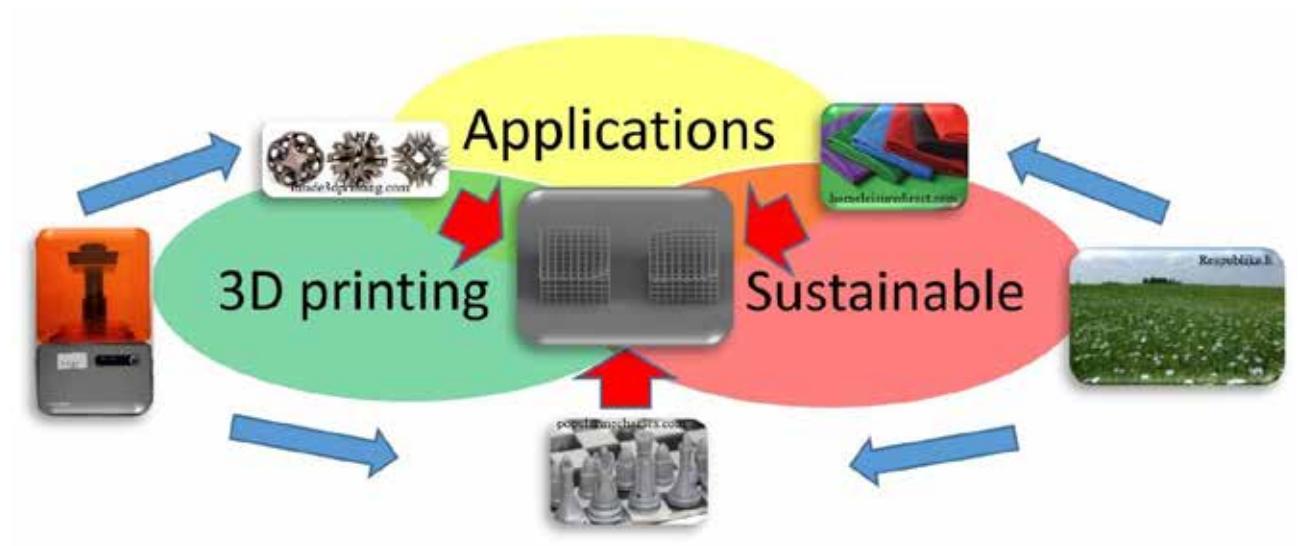
In our study, the primary chosen substance for photosensitive material synthesis was linseed oil, one of the cheapest and most abundant, non-toxic, annually renewable natural resources available in large quantities, with a high content of double bonds making it an ideal for the preparation of bio-based resins. UV mask lithography was employed to determine its photocross-linking performance and processed material properties, it was compared to FormLabs Form 1+ standard material Form Clear. Next to it, photosensitized polyethylene(glycol) diacrylates (PEG-DA) of diverse molecular weights were used as standard biodegradable materials [5]. Exposing to UV diode of 365 nm wavelength through a micro-patterned amplitude mask the materials were classified according to their: photoreactivity (cross-linking efficiency determining required exposure dose), photomodification selectivity (structuring spatial resolution limiting the finest reproducible feature), mechanical rigidity, developing and adhesive properties (shrinkage and CAD shape preservation, wettability, etc.).
These results motivate to continue studies on epoxidized linseed oil based photoresins towards their optical printing applications. Further research covers applying tabletop SLA printer Form 1+ for the manufacturing of 3D objects. The custom made biomaterials could be further functionalized doping them with biologically active compounds, for instance nano-hydroxyapatites which are well known inorganic substance for bone tissue engineering. Such organic-inorganic nanocompounds would possess improved mechanical properties and even gain shape memory features [6].