
Azopolymers have been intensively investigated as an efficient media for recording the polarization state of light. They have numerous applications in the field of polarization holography, such as data storage and diffractive optical elements with unique properties [1].
One of the most important optical parameters of the azopolymers is the value of the birefringence $\Delta n$ induced in them by illumination with polarized light. Usually, laser beam at a single wavelength is chosen as a pump and the birefringence is measured at another single wavelength, different from the pump one. On the other hand, very rarely data about the spectral behavior of $\Delta n$ are given [2,3]. Even in these cases, the birefringence is induced at a single wavelength. To our best knowledge, there are no reports about the influence of the recording laser wavelength on the photoinduced birefringence spectrum $\Delta n(\lambda)$. For this reason, in this work we present experimental data for the spectrum of birefringence, induced with pump lasers at different wavelengths: $\lambda_1 = 444$ nm, $\lambda_2 = 473$ nm, $\lambda_3 = 488$ nm.
The samples used in our experiments are thin films from an azopolymer shortly denoted as PAZO. Its chemical structure and spectrum of absorbance are shown in Fig. 1(a). The dynamics of the photoinduced birefringence $-\Delta n(t)$ is monitored in real time, measuring the Stokes parameters of a probe He-Ne laser beam ($\lambda = 633$ nm) passing through the sample. The recording continues until $\Delta n$ reaches saturation. From this measurement the following key information can be obtained: the highest value of the birefringence $-\Delta n_{max}$, response time $-\tau$ and stability -r, as illustrated in Fig. 1(b).
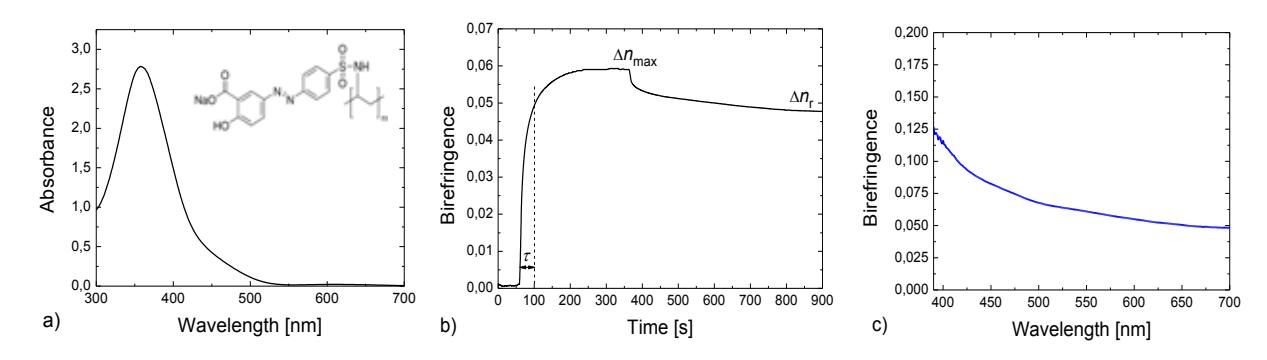
After the recording, the spectral dependence of the photoinduced birefringence $\Delta n(\lambda)$ is determined, based on the transmittance of the azopolymer sample, placed between two crossed polarizers in a spectrophotometer compartment. As seen in Fig. 1(c), values of $\Delta n$ vary from 0.05 at the longer wavelengths up to 0.12 close to 400 nm. Good coincidence is observed between the value of $\Delta n$ obtained from the real-time measurement and $\Delta n$(633 nm) – from the spectral dependence.
As indicated by our experiments, these azopolymer films can be used for recording of polarization diffractive elements, operating in the entire visible range of the light spectrum.