White light emitting diodes (WLEDs) are replacing incandescent and halogen lamps because of their energy saving and environment-friendly characteristics [1]. Nowadays commercial WLEDs are produced by combining yellow Y3Al5O12:Ce3+ phosphor and blue InGaN chip [2]. However, this combination lacks red colour emission and thus emits cool white light with high correlated colour temperature. In order to achieve warm white light for indoor lighting we need to employ a phosphor with emission in the red spectral region.
Recently, studies of inorganic fluoride phosphors doped by tetravalent manganese (Mn4+) ions attracted much attention [3]. Mn4+ ions in fluoride hosts exhibit broadband absorption ($^{4}$A2g → $^{4}$T2g and $^{4}$A2g → $^{4}$T1g) overlapping InGaN electroluminescence band and sharp emission lines due to the forbidden electron transition ($^{2}$Eg → $^{4}$A2g). Moreover, the position of Mn4+ emission lines depends on the distance between Mn-F in a host crystal. These characteristics lead to exploration of a practical red phosphor with desired optical and thermal properties.
In this study, we synthesized series of Mn4+ doped fluorides A2XF6:Mn4+ (A = K or Na; X = Si or Ti) by convenient co-precipitation method. The preparation was carried out by dissolving SiO2 or TiO2 in 40% hydrofluoric acid solution and mixing it with K2MnF6 and KF or NaSO4 at ambient conditions. Dopant concentration was controlled by adjusting the quantity of K2MnF6. Phase purity and surface morphology of obtained samples were measured using X-ray powder diffractometer and scanning electron microscope respectively. Photoluminescence properties (excitation, emission, temperature-dependent emission, quantum efficiency) and UV-vis reflectance spectra of Mn4+ in different host lattices were recorded on a spectrofluorometer.
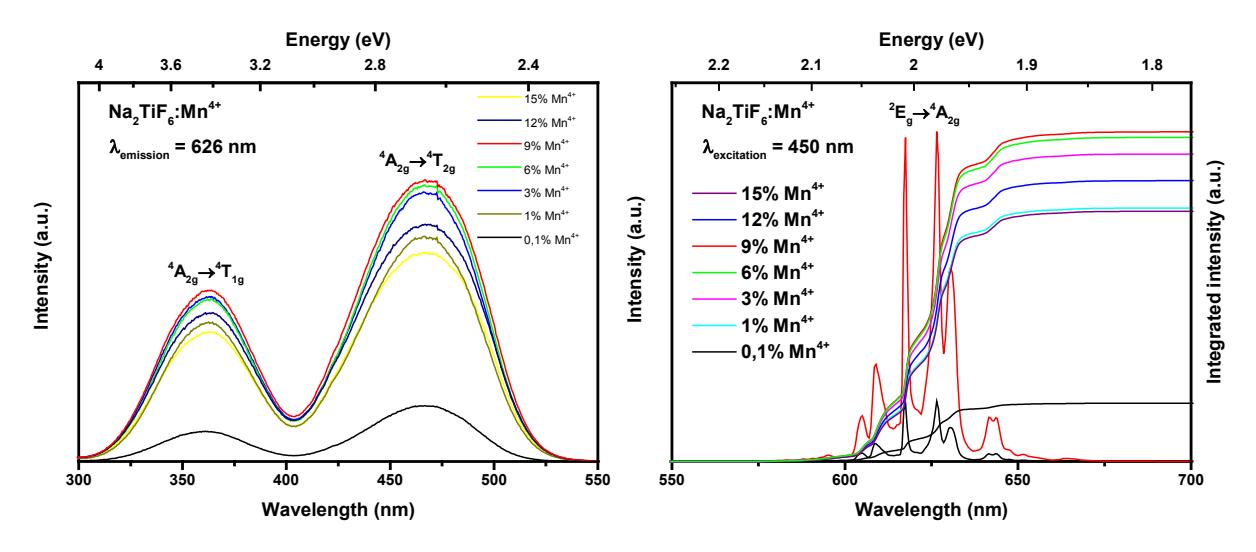
The results showed that abovementioned hosts fluorides are suitable for Mn4+ doping because of the similar ionic radius between Mn4+ and Si4+ or Ti4+. The maximum photoluminescence emission peaks were found to be situated at 626 nm (Na2TiF6:Mn4+), 627 nm (Na2SiF6:Mn4+), 630 nm (K2SiF6:Mn4+) and 631 nm (K2TiF6:Mn4+). The intensity of emission and excitation strongly depends on the concentration of the dopant (Fig. 1).