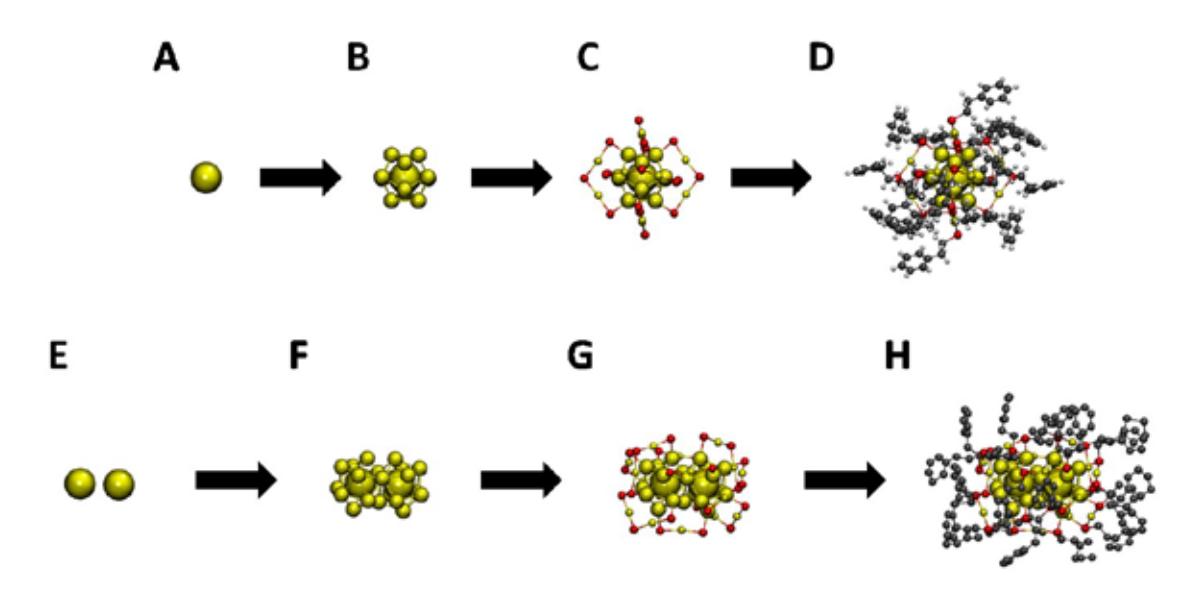
Gold superatom complexes consist of several tens of gold atoms clustered together to form a highly symmetric structure, often an icosahedron although other structures exist. Their electronic structure is characterized by the fact that they form very atom-like orbitals defined by the entire group of atoms, rather than the individual atom separately. Stable electronic configurations are those which consist of a closed shell of electrons, and as such, these structures give rise to complexes containing a magic number of atoms. To prohibit them from clustering together and precipitating in solution, they are stabilized by a monolayer of thiolate ligands.
Monolayer-protected gold particles have attracted a considerable interest from a broad range of disciplines. Unique properties emerge as a result of their size and electronic structure. Amongst their many uses, we are investigating them as promising candidates for contrast agents in nonlinear optical imaging applications, such as multi-photon excited fluorescence and second-harmonic generation (SHG) [1].
In SHG, a laser beam of particular frequency interacts with a nonlinear material and produces light of the second-harmonic frequency, or frequency doubled light, of which the efficiency is determined by the hyperpolarizability of the material. Importantly, second-order nonlinear properties can only exist in materials which do not possess inversion symmetry, on the microscopic (molecular) as well as the macroscopic (crystal structure) scale. Measuring the hyperpolarizability of particles in solution is done using the Hyper-Rayleigh scattering technique, the nonlinear variant of Rayleigh scattering [2].
Herein, we demonstrate two new mechanisms to efficiently induce SHG by means of symmetry breaking in a series of thiolate protected gold clusters consisting of 25 and 38 Au atoms; 1) ligand induced symmetry breaking and 2) doping of the central cluster core with foreign metal atoms. These mechanisms show the unique features and tailorability of Au clusters, which can be prepared with atomic definition, in contrast to larger nanoparticles, where SHG mainly arises from spherical defects.