
Core-dominated triple (CDT) blazars are pretty intriguing sources. Their nearly symmetric FR II-type lobes are faint and diffuse while the compact core is the brightest feature [1]. These radio sources are thus not consistent with the general paradigm of double-lobed extragalactic radio sources, which are normally lobe-dominated. Hence the crucial issue is to learn what is reason behind that fundamental morphological difference between these two classes.
There are three possible explanations of CDTs so far [2]. First of them suggests that a fully fledged X-shaped object is hidden behind simple triple source and the high brightness of the core is caused by orientation of one of arms that is pointed towards the observer. This arm is extremely foreshortened and Doppler-boosted. Another approach assumes the presence of a double-double radio source with enormous ratio of inner to outer linear sizes of the two pairs of lobes. The third scenario involves the unresolved double core that is not aligned with the large-scale double. This might be a newborn X-shaped source.
The image below (Fig. 1) presents an example of a CDT source. In some cases core reveals some distortions which may indicate the existence of extra substructures.
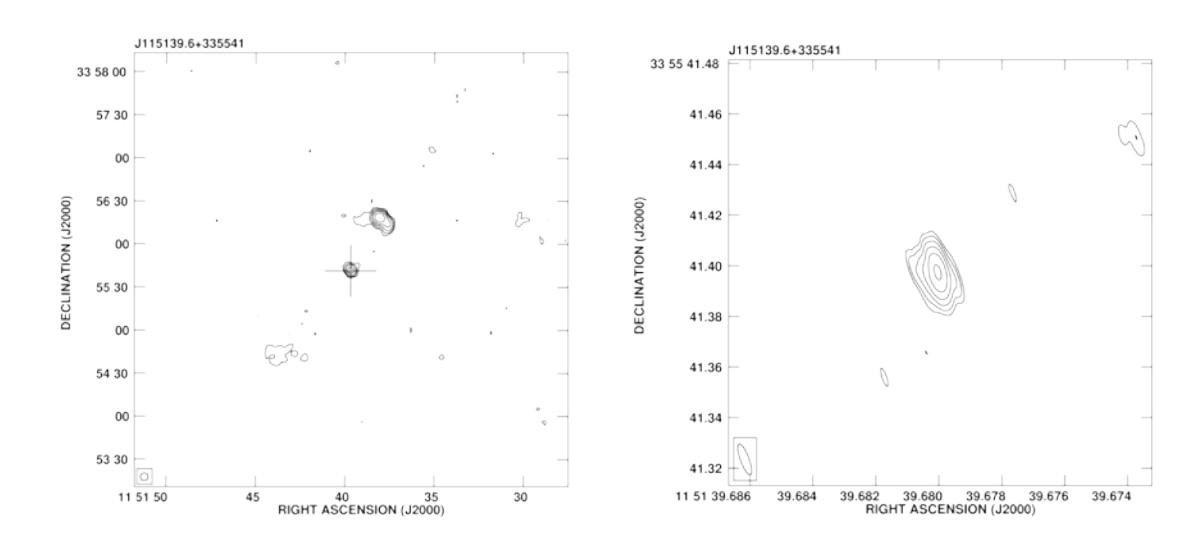
An example of untypical X-shaped source was probably found in [2]. J1625+2712 is known as CDT object, however the EVN map (Figure 1 therein) shows double core. The ratio of linear sizes of these both pairs of lobes is extremely high (~3,000). Moreover, the misalignment between these two pairs is also significant – nearly 50°.
Now we may present first results from new radio maps of J1625+2712 made by VLBA year ago. The core was observed in four frequencies what enabled us to carry out specific research about its morphology and character.