
Organic Solar cells are suffering from thermal and transition photonic losses. Thermal losses are obtained through absorption of higher than semiconductors band gap energy photons and transition losses are acquired by photons which have lower energy (IR zone) than band gap of the Solar Cell and are not absorbed. In order to lower transition losses in Solar Cells up-conversion is used [1].
Inspired with this idea we synthesized NaYF4:Yb+3 (20%), Er+3 (2%) up-converters in Vilnius University Faculty of Chemistry. These up-converters were deposited onto glass substrate covered with Indium Tin Oxide (ITO) and can improve cell efficiency. In fabrication process we used spin-casting and drop-casting methods to deposit NaYF4:Yb+3 (20%), Er+3 (2%) up-converters with different concentrations of up-converters in the solutions. These solutions were made from powder of NaYF4:Yb+3 (20%), Er+3 (2%) up-converters which were dissolved in toluene solvent. Best result is shown in figure 1.
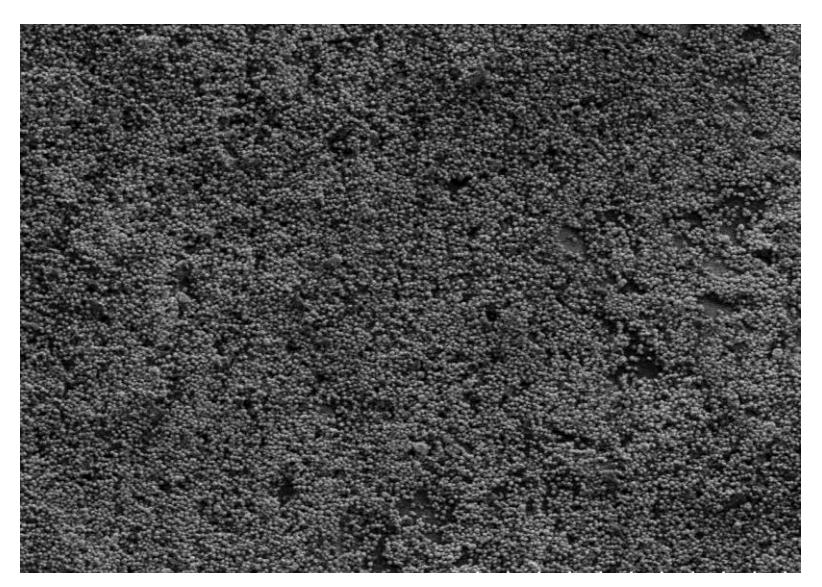
SEM images indicates that higher concentration ($c_t = 5$; 10;15 mg/ml) solutions cover substrate surface more densely in wider area. Using both methods was found out that drop-casting method is more efficient way to cover substrate surface.