The zeroth order Bessel beams are exact solutions of the Helmholtz wave equation and are invariant along the propagation direction. The intensity pattern of such beams can be considered as the interference product of plane waves propagating on a conical surface. As a result, Bessel beams consist of the high-intensity central lobe surrounded by the infinite number of concentric rings. Therefore, such non-diffractive beams carry the infinite amount of energy and cannot be generated experimentally. The approximation of such beams, called quasi-Bessel or Bessel-Gaussian beams, can be obtained for the finite spatial extent using the finite amount of energy [1]. Such beams have a greater depth of field compared to the Gaussian beam and can be applied to the formation of high aspect ratio structures in transparent materials. Another important property of Bessel-Gaussian beams is the self-reconstruction after an obstruction which reduces non-uniformities caused by perturbed beam propagation during processing [2].
Bessel-like beams were successfully applied for glass cutting applications [3, 4], micro and nano-channels formation in transparent materials [2, 5]. Even drilling of non-transparent materials, such as thin stainless steel [6] and copper foils [1], silicon [7] was demonstrated using such beams.
The aim of this research was to investigate the in-volume modification of soda-lime glass sheets using picosecond Bessel-Gaussian beams. Experiments were carried out using the fundamental harmonic of the diode-pumped solid-state lasers with a pulse duration of 10 ps and 300 ps. A conical lens with an apex angle of 170 deg together with a 4F optical system was used to transform the incident Gaussian beam into the preferred Bessel-Gaussian beam. Samples were characterized using an optical microscope and a stylus profiler.
In this research, the laser-induced modification size dependence on the laser pulse energy and 4F optical system demagnification was measured. The maximum axial length of defects was defined by the available laser pulse energy. In the case of 300 ps pulse duration, 3.4 mm-length modifications were achieved when 2.1 mJ laser pulses were applied. The formation of the unmodified zone in the volume of glass was observed and depended on the sample position in the vertical direction. The length of this zone was related to the front surface damage and was suppressed as the scanning speed was increased.
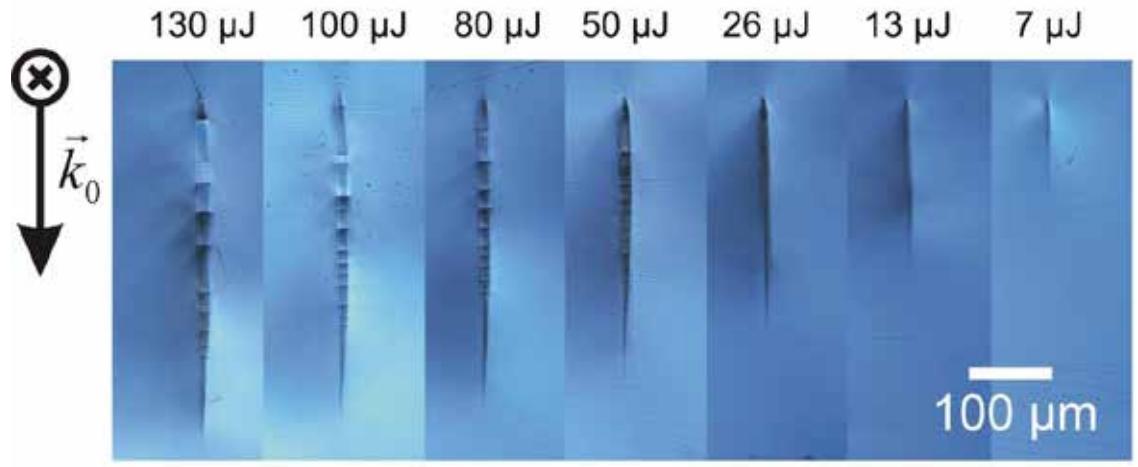
In this work, we demonstrated the formation of high aspect ratio laser induced modifications in the bulk of soda-lime glass (Fig. 1) and the possibility to vary the position of defects in the vertical direction.