
With increasing performance and declining cost, light emitting diodes (LEDs) have seen an increase in adoption for general illumination applications. LEDs are projected to reach an 84% market share in the general lighting market by 2030. The key issue in the development of high power lighting sources is the search, study and implementation of novel wavelength converters. Due to high thermal and photo stability, the glass ceramics is prospective as a matrix in production of converters in high power white LEDs [1].
We studied the influence of the glass composition and crystallization on emission of glasses doped with different rare earth elements. Barium (BaO-2SiO2) and lithium (Li2O-2SiO2) glasses were selected for the study. The glass samples were doped or co-doped with cerium, dysprosium, terbium or europium ions. The influence of crystallization was studied after transforming the doped glasses into glass ceramics by annealing it at 850°C for 1 hour. The samples were fabricated at the Belarusian State Technological University.
The study was performed by using confocal photoluminescence (PL) spectroscopy. A WITec Alpha 300 S microscopic system coupled to a spectrometer with a thermally cooled CCD camera was used. A CW laser diode emitting at 405 nm was used for excitation. The spatial resolution of 250 nm in plane and 1 μm perpendicularly to the sample surface was achieved. An integrating sphere with a xenon lamp equipped with a monochromator was used to measure the external quantum efficiency. All measurements were performed at room temperature.
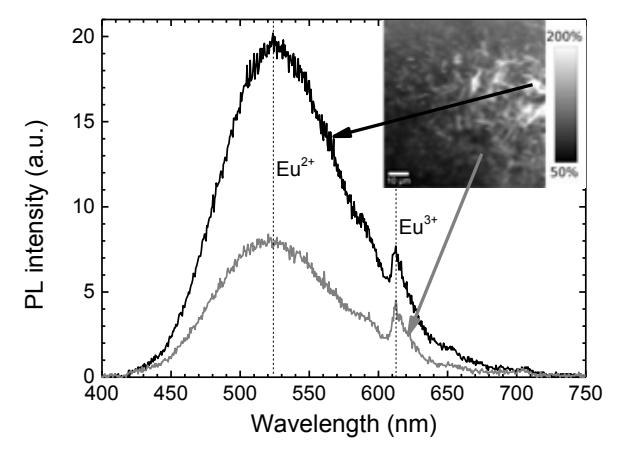
Though the distribution of PL parameters in the glass samples was found to be homogeneous, the glass ceramic samples exhibited considerable inhomogeneity. In BaO-2SiO2:Eu glass ceramics, the inhomogeneity of the PL intensity is related with the ratio between emission band due to Eu2+ and Eu3+: the ratio is larger in the needle-like bright areas. The different ratio is a result of variation in the crystallinity in the bright and dark areas. We observed that the spectral positions of the PL bands are the same in the needle-like bright areas and the dark background. This is an indication that the crystallization imposed no significant changes to the local surroundings of the europium ions.
The evaluation of chromatic properties of PL from glass samples with different dopants shows that a white light source can be fabricated using glass ceramics crystallized from an appropriate mixture of barium and lithium glasses doped with Eu, Ce, Dy, Tb. The combination of the emission from these four ions allows for optimization and tenability of the chromatic properties. We also observed that the external quantum efficiency of the glass ceramics is higher than that of the corresponding glass.