Semiconductor nanocrystals have attracted impressive attention because of their novel optical and electronic properties. Direct and wide bandgap semiconductor nanomaterials are potential candidates for applications in nonlinear optics and optoelectronics [1]. Quantum dots of CdS with the Ag nanoparticles can be used for senesitive detection cancer cells and wound healing in addition to enhancing the tumor-killing effects of anticancer drugs [2].
This work shows the studying of luminescence properties of 2 types of CdS quantum dots (QDs) in the presents of Ag nanoparticles. The sample #1 was a water solution of QDs in thioglycolic acid (TGA). The sample #2 was a solution of QDs, heated at the temperature 95°C and washed through a cellophane membrane. Optical density spectrum of QDs solution has absorption in the ultraviolet range 350-450 nm.
The water solutions of QDs have been deposited on the glass and silver gel-film substrates and dried at the room temperature in the horizontal position. Silver sol was prepared by reduction of silver nitrate with sodium citrate as described in [3]. Polydispersed silver sol formed, average particle size is about 50 nm. Optical density spectrum of silver film has the broad peak of plasmon resonance at 485 nm.
Luminescence spectra were registred with a grating (150 lines/mm) spectrograph S3901 (Solar TII, Belarus) combined with a liquid nitrogen cooled silicon CCD camera (Princeton Instruments, USA). Luminescence excitation was performed a light-emitting diode with the emission spectrum peaking at 404 nm. The luminescence spectra exposure time was 60 s.
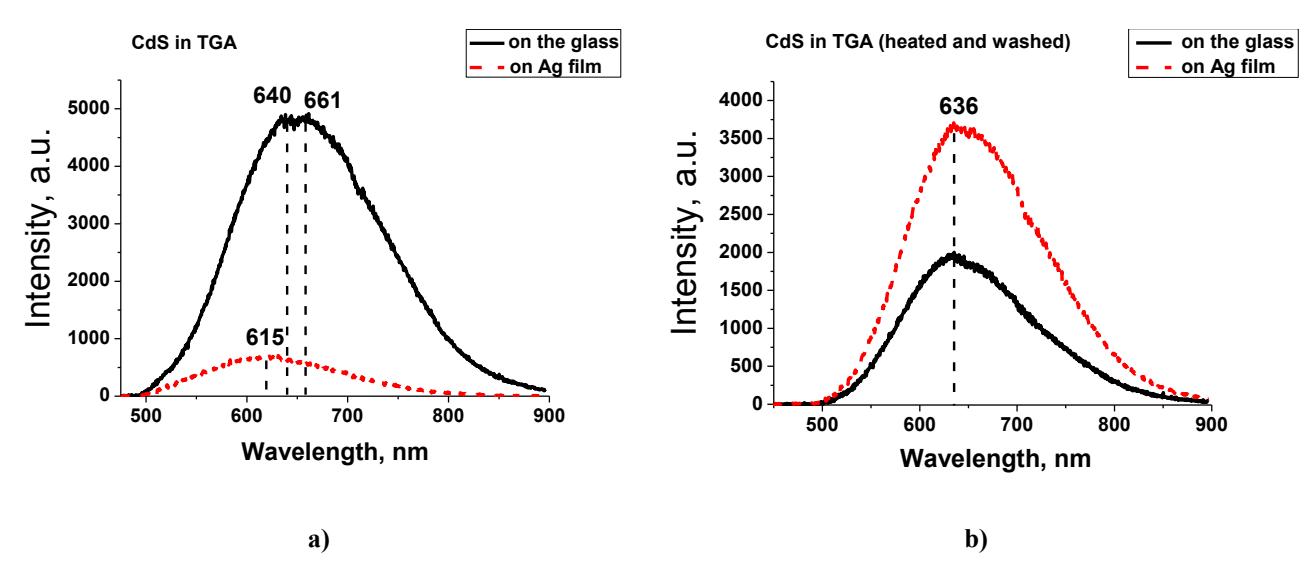
The sample #1 on the glass are characterized by the broad bands at 640 and 661 nm. The luminescence spectrum of sample #2 has the broad band at 636 nm. The presence of silver nanoparticles (NPs) led to luminescence quenching in sample #1 (Figure 1a). On the other hand we observed luminescence enhancement for the sample 2 near Ag NPs (Figure 1b).
The decay time of luminescence depends on the probability of radiation and non-radiation transitions. The presence of metallic nanostructures may increase probabilities of both radiative and non-radiative transitions [4]. According to our experimental data the luminescence decay times decreased in the presents of Ag nanoparticles on 2.4 ns and 2 ns for samples #1 and #2, respectively. The decay times acceleration are caused by increasing the probability of non-radiation transitions. However, since sample #2 has a low quantum yield on the glass surface, competitive processes of radiation and non-radiation transitions could be occur in the presents of Ag nanoparticles and led to increasing the luminescence intensity.
So, QDs of CdS heated up to 95 °C are prespective as the markers for cancer treatment with the Ag nanoparticles.